Updated July 2026 · 7 min read · Mert Aytunur · Mechanical Engineer, University of Illinois Chicago
What does vendor lock-in look like in a machine vision project?
Lock-in in machine vision is rarely a single decision. It builds up from small dependencies that each looked reasonable at purchase time. A per-camera software licence you must keep renewing to go on inspecting. A cloud service the inference quietly depends on. A camera, a lighting rig and an analytics package from three different suppliers, each with its own release cycle. Any one of them can become the reason a working line stalls.
The pattern most quality and OT teams recognise is the multi-vendor blame loop. When a defect escapes, the camera vendor points at the lighting, the lighting supplier points at the software, and the software vendor asks for logs that live on someone else's hardware. No single party owns the outcome, so the cost of diagnosis lands on your plant. These are industry-general patterns, not a claim about any one competitor, but they describe the friction a buyer is trying to avoid.
The second trap is the data-export requirement. If raw part images have to leave the line to a vendor cloud to train a model or even to run an inspection, then your imagery, and often sensitive process detail with it, sits outside your control. Changing supplier later means untangling both the hardware and the data.
None of these dependencies announces itself at purchase. Each surfaces later, when a licence renewal lands, a cloud endpoint is deprecated, or a camera you counted on is quietly discontinued, which is precisely when a running line can least afford the disruption. Lock-in is a cost you pay at the worst possible moment, not on the day you sign.
How does building the camera, lighting and AI in-house change the accountability?
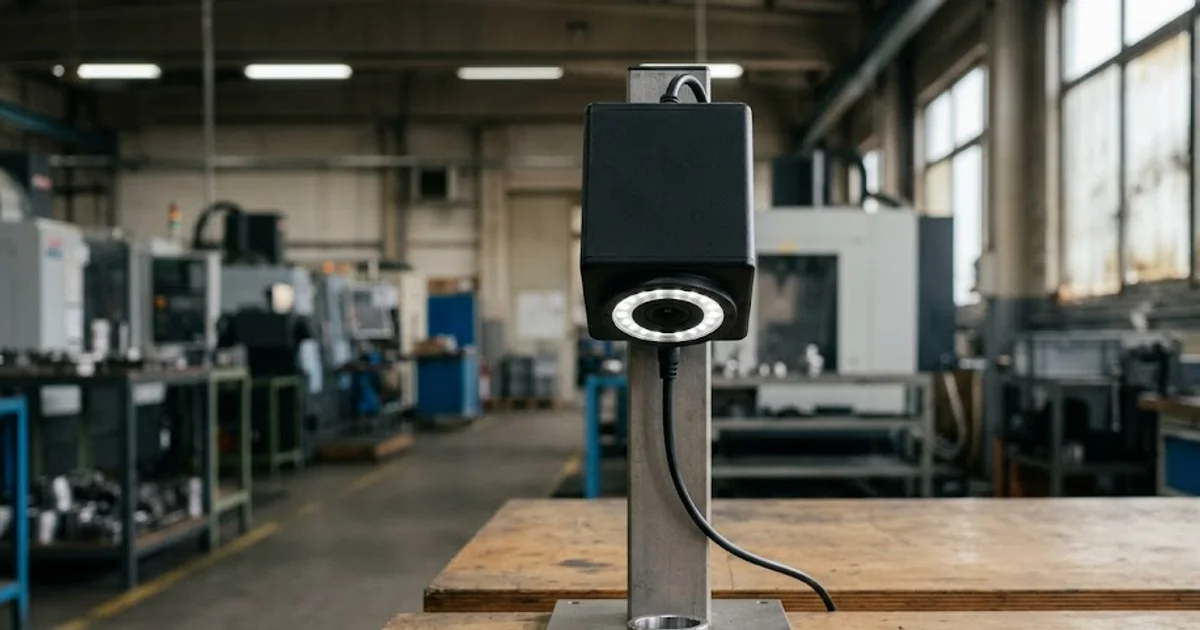
When one supplier designs the camera, the lighting, the edge compute and the AI model as a single unit, the blame loop collapses into one accountable party. There is one place to call, one release cycle, one support path for the whole inspection stack. Adente Vision is an edge-AI visual inspection unit built by ADENTE Advanced Engineering Technologies, part of the Aden Group, sold through automation system integrators, and that end-to-end build is the point: the optics, the lighting, the fanless Jetson-class compute and the model are co-designed rather than assembled from separate catalogues.
Co-design also changes what a later variant costs you. Because the model, the sensor and the lighting were tuned together, adding a new part is a training task on the same unit, not a fresh integration between vendors who have never met. The dependency you are managing is one supplier's roadmap, not the intersection of three.
Why does on-device processing matter for avoiding a data-export trap?
On-device processing keeps the two things a vendor can hold hostage, your inference and your images, inside the plant. Inference runs on a fanless Jetson-class board in the enclosure, so a decision does not depend on a subscription staying live or a cloud endpoint staying reachable. Model updates arrive by USB stick, which means the unit runs on an air-gapped line with no inbound internet path at all.
That design directly answers the data-export trap. Raw part imagery is processed where it is captured and does not leave the line, so there is no vendor cloud accumulating your process data as a side effect of inspection. For the fuller treatment of why edge inference beats a cloud round-trip on latency and data control, see the sibling post on edge versus cloud visual inspection.
Where does lock-in usually bite, and what does an integrated unit answer?
Each classic lock-in risk has a concrete counterpart in a vertically integrated unit. The table maps the risk to the answer.
| Lock-in risk | How it shows up | What an integrated unit answers |
|---|---|---|
| Proprietary licence | A per-seat or per-camera licence you renew to keep inspecting | Camera and AI are built together; no separate licence gates the line |
| Cloud dependency | Inspection stops or degrades if a subscription or cloud lapses | Inference runs on-device on a fanless Jetson-class board; updates by USB |
| Multi-vendor blame | Camera, lighting and software point at each other on an escape | One supplier owns the camera, lighting, edge compute and model |
| Data-export trap | Raw images must leave the line to a vendor cloud | Images stay on the line; raw imagery never leaves the plant |
| Discontinued hardware | A third-party camera goes end-of-life and the software no longer matches a replacement | Optics, compute and model are co-designed and supported as one unit |
What does vertical integration mean for the integrator who installs it?
For an automation system integrator, single-supplier accountability is a commercial argument, not just a technical one. Adente's channel line is direct: we sell through integrators, not around them. The integrator installs the unit, keeps the end customer relationship and does not have to become a vision specialist or babysit three separate vendor contracts to keep the cell running.
That matters because a multi-vendor stack quietly erodes an integrator's margin. Every coordination call, every version-matching exercise, every finger-pointing session is unbilled time. A unit that mounts in about 30 minutes by one person, under 9 kg, and speaks the protocols the cell already uses removes most of that overhead. The integrator's margin sits in the deployment and the customer relationship, not in reconciling suppliers. The unit reaches a line through an integrator partner in the first place.
When is a single-supplier stack still a risk, and how do you de-risk it?
Concentration is the honest counter-argument: leaning on one supplier is itself a form of dependency. The mitigation is open interfaces at the boundaries. A unit that outputs pass/fail and results over open industrial protocols, PROFINET, EtherNet/IP, Modbus TCP, EtherCAT and OPC UA, does not lock its results into a proprietary bus, so the line controller, the MES and the historian stay yours regardless of the inspection vendor. Open protocols such as OPC UA, published by the OPC Foundation, are exactly the seam that keeps a single-supplier unit from becoming a closed island.
So the useful question is not "one supplier or several," it is "where are the interfaces open." Vertical integration inside the unit, plus open standards at its edges, gives you a single accountable party without a closed data path. For a closely related read on why co-designed optics and compute beat a bolted-on camera, see the sibling post on in-house versus third-party cameras.