Updated July 2026 · 8 min read · Serkan İnkaya · Mechanical Engineer, ODTÜ
What is the matching problem between a camera and an AI model?
The hardest part of a vision deployment is often not the model, it is making the image feed the model actually needs. Sensor resolution, shutter type, lens focal length and working distance, and the lighting angle and colour all decide whether a defect is even visible in the frame. Get the lighting wrong and a scratch on a shiny surface disappears; pick a rolling-shutter sensor for a fast line and the moving part smears.
When the camera is chosen from a catalogue first and the software is adapted to it afterwards, this matching happens by trial and error at commissioning. The team tunes lighting against a model that was never trained on that exact optical setup, and every mismatch becomes rework on-site. This is an industry-general failure mode, not a claim about any one product, but it is the reason two vision projects with identical parts can land months apart.
Co-designing the optics with the model turns matching into a design decision instead of a field problem. The sensor, lens and lighting are selected because the model was developed and validated against that combination, so the image the model sees on your line resembles the image it learned from.
That also shortens commissioning. The lighting geometry and exposure that make a defect visible were fixed at design time rather than discovered by a technician standing at the cell with a test part, so the cell reaches a stable result faster and the model behaves the way it did in validation. What is left for the technician is physical, mounting the unit and framing the part, and even that is a job you can finish at the cell by aiming an inspection camera without a laptop.
What does Adente Vision's in-house optics and compute stack specify?
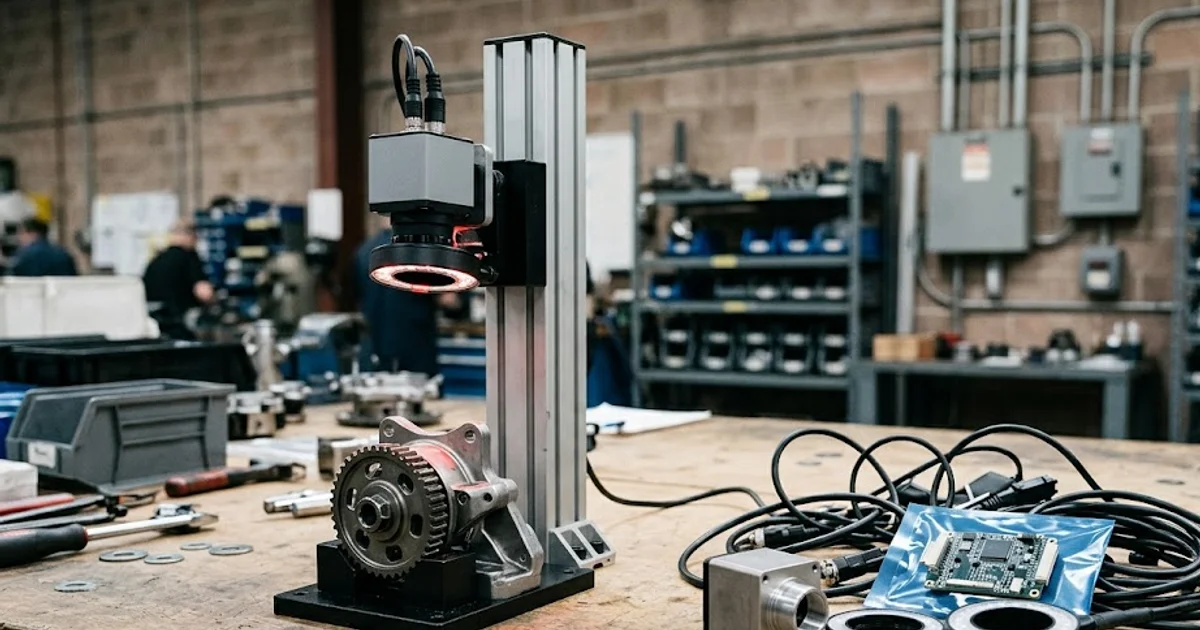
Adente Vision is an edge-AI visual inspection unit built by ADENTE Advanced Engineering Technologies, part of the Aden Group, sold through automation system integrators, and the optics, lighting, edge compute and model are built together rather than bolted on. The camera is up to 12 MP, global shutter, C-mount, so fast-moving parts are captured without motion smear and the lens is a standard, serviceable mount rather than a proprietary fitting.
Lighting is configurable in colour and angle, diffuse, directional or coaxial, on a 24V supply, which is what lets the unit reveal a surface defect that a fixed ring light would wash out. Inference runs on a fanless Jetson-class board with 8-16 GB, co-located with the sensor in the enclosure. Because the same team owns the sensor choice, the lighting geometry and the model, the specification is a known baseline you can plan a cell around, not a variable that depends on which catalogue camera a supplier had in stock.
Why does compute next to the sensor keep latency low?
Putting the compute beside the sensor removes the network hop between seeing a part and deciding on it. There is no image transfer to a separate PC or a cloud endpoint before inference runs; capture, model and decision live in the same enclosure. On a delivered line the measured result is about 30 ms per part, which is the envelope, not a promise: the number you can commit to for your own cycle depends on your parts, resolution and lighting and needs an application-specific measurement.
A bolted-on architecture, by contrast, sends each frame from a third-party camera to separate software elsewhere, and every hop adds latency and one more thing that can fall out of sync. Co-location is why an edge unit can decide per part at line speed rather than on a sample. For the decision of when a learned model is the right tool at all versus a rule-based check, see the sibling post on rule-based versus AI machine vision.
In-house co-designed vs third-party bolted-on: what differs?
The two approaches differ on five practical dimensions, from how optics are matched to who you call when a part escapes.
| Dimension | In-house co-designed unit | Third-party camera plus separate software |
|---|---|---|
| Optics matching | Sensor, lens and lighting tuned to the model | Camera picked from a catalogue, then software adapted |
| Latency path | Compute beside the sensor, ~30 ms measured on a field line | Image hops to a separate PC or cloud before a decision |
| Support path | One supplier for camera, lighting, compute and model | Coordinate a camera vendor and a software vendor |
| Updates | Model and firmware from one source, by USB | Two update cycles to keep in step |
| Spec transparency | Known baseline: 12 MP global shutter, C-mount, 24V lighting | Depends on which catalogue camera was fitted |
What does a single support path change day to day?
A single support path changes who is accountable when something drifts. With a co-designed unit, one supplier owns the camera, the lighting, the compute and the model, so a lighting question and a model question go to the same place and are answered against the same validated setup. There is one firmware and model update stream, delivered by USB, so the optics and the software never fall a version apart.
With a third-party camera and separate analytics software, you coordinate two roadmaps. A camera firmware update can change the image just enough to move the model's behaviour, and reconciling that is your team's job. None of this makes a two-vendor setup unworkable, but it is unbilled coordination time that a single accountable unit removes. To see where single-supplier accountability fits the wider method, see the pillar guide on AI visual inspection.
When does a third-party camera still make sense?
A co-designed unit is not the answer to every imaging problem, and it is worth being honest about where a third-party camera fits better. If your task needs a sensor outside the standard envelope, line-scan for continuous web material, thermal or hyperspectral imaging, or resolution beyond the integrated camera's range, a specialised third-party camera may be the only way to get the image at all.
You may also already run a standardised camera fleet across a plant and want every station to use the same model for spares and training reasons. In those cases the coordination cost is a deliberate trade for flexibility or standardisation. The co-designed unit wins when the task sits inside its optical envelope and you value one accountable supplier, a known spec and low latency over the freedom to swap the sensor. Match the architecture to the task, the same way you would match rule-based against AI.