Updated July 2026 · 6 min read · Serkan İnkaya · Mechanical Engineer, ODTÜ
How do you retrofit AI inspection onto an existing line controller?
Retrofitting AI inspection onto an existing controller starts with a question, not a purchase: what protocol does the controller already speak. You read the brownfield line's existing bus first, then match the inspection unit to it, so the controller sees a familiar signal rather than a new system it has to be re-architected around.
That order is what keeps a retrofit from turning into a rebuild. On a greenfield line you design the network once; on a brownfield line the network already exists, the PLC is programmed, and the last thing you want is to re-lay the bus for one inspection point. Matching the existing protocol means the pass/fail or coded result drops into the controller's world with a tag change, not a re-commission.
Adente Vision is an edge-AI visual inspection unit built by ADENTE Advanced Engineering Technologies, part of the Aden Group, sold through automation system integrators, and it is designed to drop onto an existing controller: it carries its own compute, so there is no new PC or cloud to add to a line that was never built for one.
Which controllers does the unit actually connect to?
The unit connects to a brownfield controller in one of two ways: over the fieldbus it already speaks, or over plain discrete wiring when a bus port is not free. It supports five industrial protocols, PROFINET, EtherNet/IP, Modbus TCP, EtherCAT and OPC UA, plus 4 inputs and 4 outputs at 24V, and in industrial automation that set covers the large majority of installed controllers.
The two-tier coverage is what makes the retrofit predictable. If the line runs PROFINET on a Siemens PLC or EtherNet/IP on a Rockwell PLC, the result rides that bus. If the controller is older, mixed, or has no spare fieldbus capacity, four discrete outputs carry pass, fail, ready and fault without touching the network at all. Modbus TCP sits in the middle as the vendor-neutral path almost every controller can read.
None of this asks the existing program to change its architecture. The inspection result appears as a signal the controller already understands, so the PLC logic gains a check, not a dependency on a new subsystem.
Protocol coverage for a brownfield controller
Match the unit to what the controller already speaks; the coverage below is why most brownfield lines connect without re-laying a bus.
| If the controller speaks... | The unit carries the result over... | Retrofit note |
|---|---|---|
| PROFINET | PROFINET | Common on Siemens lines, match the existing bus |
| EtherNet/IP | EtherNet/IP | Common on Rockwell lines |
| Modbus TCP | Modbus TCP | Vendor-neutral path most controllers read |
| EtherCAT | EtherCAT | For motion-synchronized, high-speed cells |
| OPC UA | OPC UA | For structured per-part results to MES |
| No spare bus port | 4-in / 4-out 24V discrete | Pass, fail, ready, fault without touching the fieldbus |
Why does a self-contained unit simplify a brownfield retrofit?
A self-contained unit simplifies the retrofit because the compute is inside the enclosure, so nothing new has to be provisioned on the line. Inference runs on a fanless Jetson-class board in the unit, which means no inspection PC to rack, no server to maintain, and no cloud connection to open through a plant firewall that was never meant to face the internet.
Keeping the compute local also keeps the data local. Every image is processed on the unit, so raw part imagery stays on the line and only the result leaves, which matters on a brownfield line where sending frames off site may not be permitted and often is not wired for. The unit is the OPC UA server and the fieldbus endpoint itself, not a sensor feeding a separate box. In a plant that separates its OT and IT networks, that keeps the whole vision cell on the OT side, and the placement rules behind it are set out in the post on segmenting a vision cell between OT and IT.
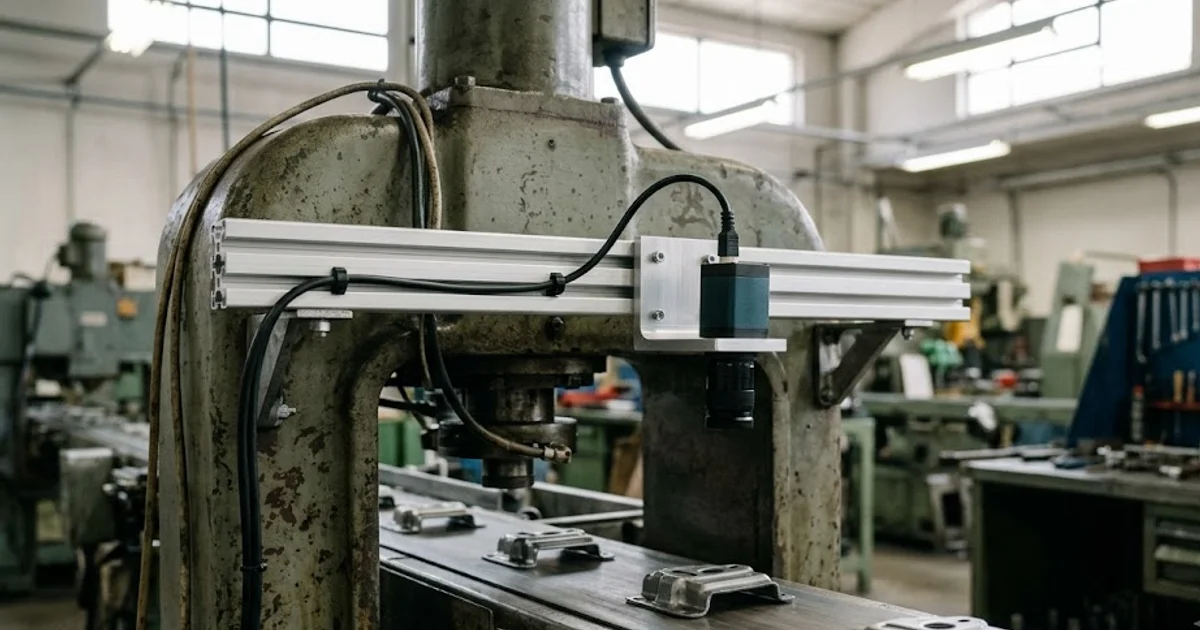
The physical retrofit is a one-person job. The enclosure weighs under 9 kg, so a single technician mounts it without a lift or a second pair of hands, and the AV-S100 standard unit fits a dry assembly or machining cell at IP54. Less to install means less of the existing line disturbed.
How long does the retrofit take on the floor?
Box to first inspected part is about 30 minutes for one person, in four steps: Mount, Aim, Configure, Wire. On-device preview makes aiming and light adjustment a no-laptop operation, so the technician sets the framing on the unit itself rather than trailing a PC to the cell.
The Wire step is where the protocol-match work pays off. Because the target bus or the discrete map was chosen up front from what the controller already speaks, wiring is connecting to a known interface, not discovering one on the floor. That is the difference between a half-hour field task and a multi-day integration.
For air-gapped brownfield lines, model updates arrive by USB stick, so a line with no internet path can still be updated without opening a network hole. For the full four-step field method, see the sibling post on installing AI inspection in 30 minutes, and for carrying structured results up to MES on the matched bus, see the note on OPC UA for inspection. The pillar guide on AI visual inspection covers the method; the integrator model behind it is what carries the retrofit on site.