20 August 2026 · 6 min read · Mert Aytunur · Mechanical Engineer, University of Illinois Chicago
Ask any automation integrator why they hesitate on a vision job, and you will hear the same thing: it is not the camera, it is the project. A traditional vision deployment means scoping the line, engaging a vision specialist, running a months-long integration, and shipping a custom rig only that specialist can service. The integrator carries the schedule risk and the customer pays a specialist's fee, for a result nobody else can maintain.
It does not have to work that way. When the vision engineering is done once, at the factory, and the unit ships pre-configured for the part class, installation becomes a service task your own team can finish in about 30 minutes. Here is how.
Why the old six-month model exists, and why it's avoidable
The long project is not a law of physics; it is a consequence of doing the engineering at every site. In the classic model, each deployment re-does the camera selection, the lighting design, the model training and the integration from scratch, on the line, with a specialist present. Everything is bespoke, so everything is slow.
The alternative is to move that work upstream. The camera, lighting, edge compute and inspection software are matched and tested at the factory for the part class, and the model ships trained. What is left on the line is not engineering, it is installation: physically mounting the unit, aiming it, choosing the mode, and wiring it to the PLC. That is the difference between a project and a task. Training a model for a genuinely new part is the other half of that clock, and at under 48 hours it changes what a changeover costs.
The four steps: Mount, Aim, Configure, Wire
A pre-configured unit installs in four steps, and none of them needs a vision background.
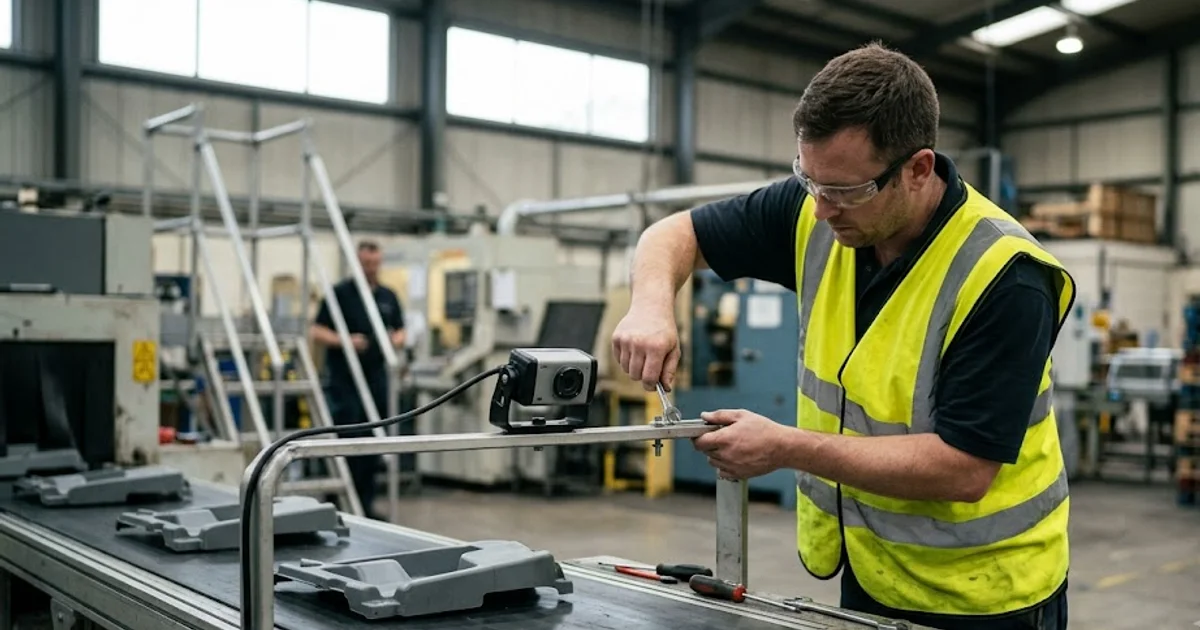
- 01Mount. Bolt the enclosure to the line frame at the inspection point. On a unit under nine kilograms, one person handles it without a hoist; a standard bracket fits common aluminium profile.
- 02Aim. Frame the part using the on-device preview. Because the preview shows the framed region and lighting coverage in real time, aiming the camera is a matter of seconds, no laptop, no calibration chart taped to a fixture.
- 03Configure. Choose the inspection mode and set a tolerance, or load the reference set the unit shipped with. This is a selection, not a programming exercise.
- 04Wire. Connect the unit to the PLC over an industrial protocol or discrete I/O, and choose how it triggers, an encoder pulse, a photoelectric sensor, or a fixed interval. The unit returns a pass/fail per trigger, like any other device on the line.
Mount, aim, configure, wire. The whole sequence is roughly 30 minutes on a typical line, and every step is inside the skill set an integrator's service team already has. From the first shift afterwards the station returns a verdict on every part, and that record is what a quality team turns into a defect rate in PPM or DPMO.
What you need on the line
You do not need much, and you almost certainly have it already.
- A mounting point at the inspection position that sees the part clearly, standard profile is fine.
- A trigger source so the unit knows when a part is in frame: an encoder pulse, a photoelectric sensor, or a fixed interval.
- A PLC connection over a supported protocol, PROFINET, EtherNet/IP, or discrete I/O are the common choices, to receive the pass/fail result.
- Power at the point of installation.
Notice what is not on this list: a vision engineer, a laptop running specialist software, a cloud account, or a separate integration project. The unit is designed so the line-side requirements are the ones a controls or automation technician meets every day.
Who owns the deployment afterwards
This is the part that matters most for an integrator. In the old model, the vision specialist stays in the loop forever, because they are the only one who understands the custom rig, which means the specialist, not the integrator, owns the customer relationship on that line.
With a pre-configured unit, that dependency is gone. For a first deployment you can pair with the manufacturer's engineering if you want the reassurance, but from the second unit onward it is yours to commission. Your service team installs it, your team supports it, and the relationship that matters, the one between you and your customer, stays with you. The manufacturer supplies a product; you deliver the solution. (For the full picture of how the unit is built and installed, see the AI Visual Inspection guide .)