Updated July 2026 · 7 min read · Serkan İnkaya · Mechanical Engineer, ODTÜ
What does the classic camera-plus-server stack actually contain?
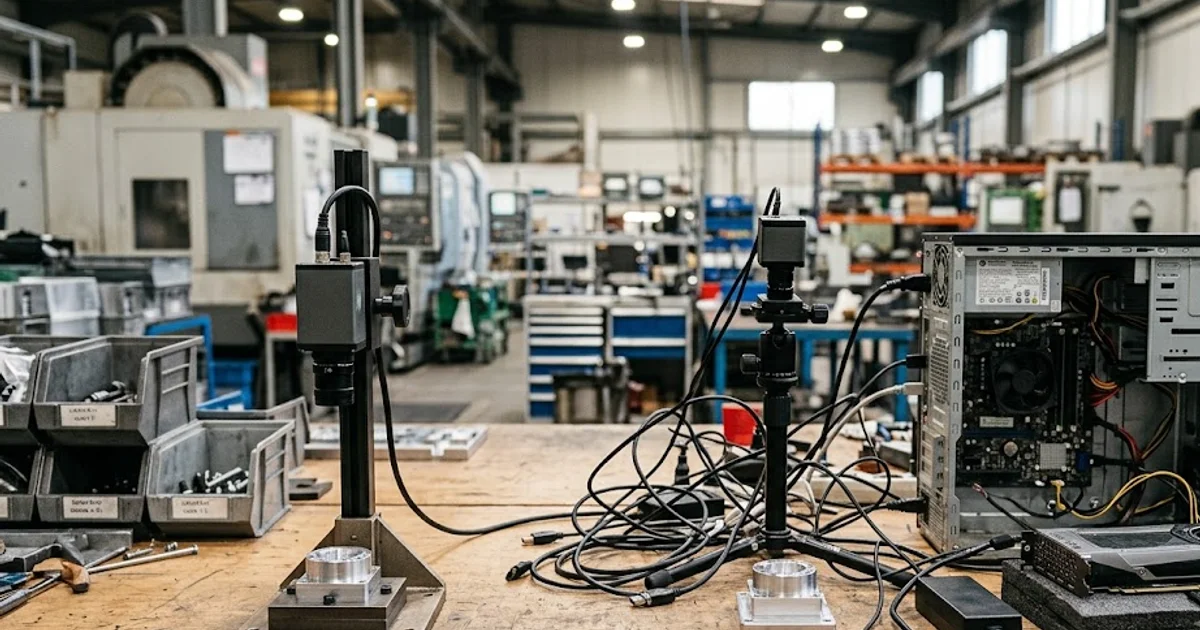
A classic machine-vision rig is not one device; it is a chain of them. A typical build has an industrial camera, a lens, dedicated lighting with its own controller, a cable run to a frame grabber, a PC or industrial server holding the grabber, often a separate GPU for the AI model, and the network and power feeding all of it. Each item is sourced, mounted, wired, configured and, later, maintained.
That chain exists for historical reasons. Cameras were dumb sensors, so the compute lived in a PC nearby, and the two were joined by a grabber and a cable. It works, but the part count is the point: a station that inspects one part is running five or six pieces of hardware and the connections between them, each with its own firmware, driver, mounting and mode of failure.
For a production or maintenance manager, that part count is the whole story. Every box in the chain is something to specify, something to stock a spare for, and something that can be the reason the line is down at 2 a.m.
How many failure and maintenance points does a distributed rig add?
Every box and every cable in a distributed rig is an independent point of failure, and they multiply rather than add. A loose grabber cable, a PC that decides to install updates, a GPU driver mismatch, a fan clogged with plant dust, a lighting controller that drifts: any one of them stops the inspection, and diagnosing which one takes time because the fault could be in any link of the chain.
Maintenance load scales with that part count too. A PC on the floor is a general-purpose computer in an industrial place it was not built for, with an operating system to patch, storage that fills, and fans that fail. Spares strategy gets harder because you are stocking several distinct parts from several vendors, and a repair often means matching firmware and driver versions across boxes before the station runs again.
None of these are exotic failures. They are the ordinary friction of running distributed hardware in a factory, and they are exactly the friction a single-enclosure design is built to remove.
What does collapsing the stack into one unit change?
Collapsing the stack means the camera, the lens, the lighting, the edge compute and the AI model live inside one enclosure, so the cable runs, the grabber and the floor PC disappear. Adente Vision is an edge-AI visual inspection unit built by ADENTE Advanced Engineering Technologies, part of the Aden Group, sold through automation system integrators. It is designed as one box for exactly this reason.
The standard unit is a 320 x 240 x 180 mm enclosure weighing under 9 kg, rated IP54, with inference running on a fanless Jetson-class board and a camera of up to 12 MP with a global shutter. Fanless matters in a dusty plant because a fan is a moving part and an intake for contamination. IP54 matters because the electronics are sealed against the environment rather than sitting in an office-grade PC case on the floor. Because Adente builds the camera, lighting, compute and AI in-house, the pieces are designed to work as one unit rather than integrated from separate vendors on site.
The reliability effect is a smaller failure surface. There is no grabber cable to work loose, no separate PC to patch, no GPU driver to match, and no fan to clog. What was a chain of six things to keep alive becomes one sealed unit to mount and power.
Distributed stack versus one unit
The table sets the classic rig against the single-enclosure design on the things a production and maintenance team actually carry.
| Concern | Distributed camera-plus-server stack | One edge unit |
|---|---|---|
| Hardware pieces | Camera, lens, lighting, grabber, PC, GPU, cabling | Single enclosure, camera and lighting and compute inside |
| Failure points | Every box and cable is independent | One sealed unit, no grabber cable or floor PC |
| Cooling | PC and GPU fans (dust intake) | Fanless Jetson-class board |
| Spares | Several parts from several vendors | One unit to stock |
| Install | Mount and wire each piece, match versions | Mount, aim, configure, wire one box |
What does one-box design do for install time and spares?
One box changes install from an integration project into a mounting job. Because the camera, lighting and compute are already matched inside the enclosure, there is no on-site pairing of grabber to PC to GPU, no driver reconciliation, and no rack to build. The standard unit mounts in about 30 minutes by one person, since it weighs under 9 kg, in four steps: mount, aim, configure and wire.
Spares get simpler in the same move. Instead of stocking a camera, a grabber, a PC and a GPU and hoping the firmware still matches on the day you need them, you hold one unit. A swap is a swap of the whole inspector, not a diagnosis across a chain, which shortens the time a station sits down and keeps the maintenance decision inside the cell. For the full step-by-step, the sibling post on installing an AI inspection in 30 minutes walks the mount, aim, configure and wire sequence.
What is the honest limit of one box?
The honest limit of one box is that one unit is one viewpoint. A single enclosure sees the part from where it is mounted, and no amount of integration changes the physics of a single camera position. If your inspection needs several angles, the underside and two sides of a part, or full wrap-around coverage, that is more than one viewpoint and therefore more than one unit or station.
That is a design question, not a defect, and it is the same question a distributed rig faces: a single camera on a PC is also a single viewpoint. The one-box argument is about removing the grabber, the floor PC and the cabling for each viewpoint you deploy, not about claiming one enclosure sees everything. Size the number of units to the number of views your part actually needs, and treat multi-view coverage as an application decision to measure, not an assumed capability.
This post is a spoke of the pillar guide on AI visual inspection; to see how the camera, lighting, compute and AI sit in one enclosure, see the Adente Vision system.