Updated July 2026 · 8 min read · Serkan İnkaya · Mechanical Engineer, ODTÜ
What is the physical and electrical envelope a cell designer needs?
The physical and electrical envelope is the set of hard constraints an inspection unit imposes on a cell before any software matters: its size, its weight, its power input, its heat output and its environmental limits. A cell designer sizes the mounting, the power feed and the thermal margin around these numbers, so they have to be settled before the AI, the optics or the inspection task enter the picture.
This is the part of a vision project that is easy to defer and expensive to get wrong. A unit that needs a dedicated power supply, a special mount or forced cooling changes the bill of materials and the panel layout of the cell, and those changes surface late if the envelope was not checked at design time. Adente Vision is an edge-AI visual inspection unit built by ADENTE Advanced Engineering Technologies, part of the Aden Group, sold through automation system integrators, and it is specified to drop into a standard cell without a dedicated supply, a two-person lift or an added cooling path.
The rest of this post walks the envelope in the order a cell designer meets it: power, then mounting, then thermals and humidity, then the field flow that turns the specification into a working station in about 30 minutes.
How does the unit get its power?
The unit runs from a universal 90-240 VAC input at about 60 W typical, so it accepts standard single-phase mains anywhere in the world without a dedicated or regulated supply. That wide input range means the same unit works on a 110 V and a 230 V line without a hardware change, and the modest 60 W draw keeps it well within the budget of an ordinary cell power feed.
For a panel designer, universal input removes a component and a decision. There is no separate 24 V brick to size for the compute, no regional power variant to stock, and no special circuit to provision, because 60 W is a small load next to the actuators and drives already in the cell. The unit still uses 24 V on its discrete I/O side, 4 inputs and 4 outputs for triggers and pass/fail signalling, but its own operating power is standard AC mains. Keeping the power simple is part of what lets one person commission the station rather than needing an electrician for a bespoke supply.
How do you mount a unit this size, and by how many people?
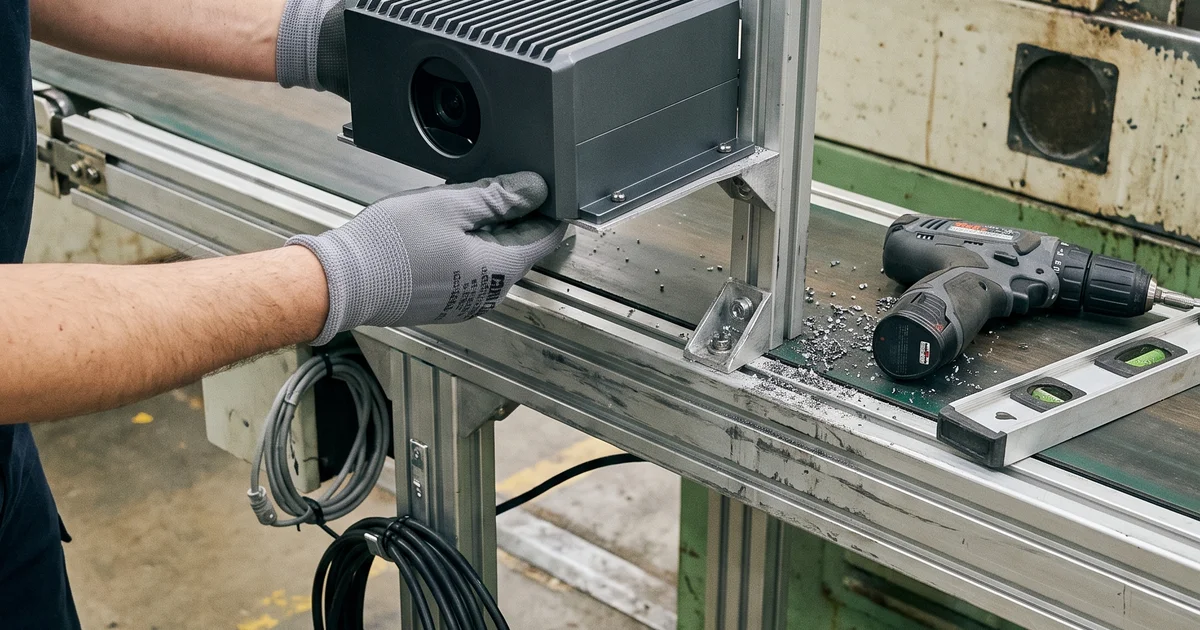
A unit of 320 x 240 x 180 mm weighing under 9 kg is a one-person mount, light enough for a single installer to position and fix without a lift or a second pair of hands. The compact footprint means it fits on a standard bracket or profile rail beside the inspection point rather than needing its own frame or cabinet space.
Weight is the property that decides the mounting method. Under 9 kg keeps the unit in the range a person can hold in position while fixing the bracket, which is why the standard install is described as one person from box to first inspected part in about 30 minutes. The size matters for reach and viewing angle: at 320 x 240 x 180 mm the unit tucks into the working envelope of most cells without blocking access or fouling the robot path, and because the compute is inside the same enclosure there is no separate PC box to find panel space for. For the step-by-step field workflow behind that 30-minute figure, see the sibling post on installing AI inspection in 30 minutes.
How does a fanless unit stay cool on a hot line?
A fanless unit sheds heat by conduction through its enclosure rather than by drawing air across the electronics, so it holds its rated temperature without a vent or a fan that could clog. The standard configuration is specified for 0-45 C ambient at 10-90% humidity, and the high-temperature AV-H100 variant extends that to 0-65 C for hot processes.
For a cell designer, fanless changes the thermal calculation. There is no cooling airflow to provide and no filter to service, and the sealed body that carries the heat out is the same body that keeps dust, mist and coolant out, which is why the unit can be rated to IP54 under IEC 60529 in the standard AV-S100. The consequence for layout is that the unit only needs enough surrounding space for its enclosure to radiate, not a forced-air path, so it can sit close to the process. Where the ambient can exceed 45 C, near a furnace, a glass works or a hot-stamping press, the AV-H100 is the variant to specify, with its enclosure rated to 0-65 C while sharing the same optics and compute. Humidity is accommodated across a wide 10-90% band, covering both dry machining halls and damp washdown-adjacent areas.
What does the physical and electrical envelope look like on one page?
The table below is the cell-designer summary of the standard unit: the numbers to size the mount, the power feed and the thermal margin around. The AV-H100 shares these figures except for its extended 0-65 C operating range. Machine builders read the same table as an integration specification when they embed edge-AI inspection inside their own machine rather than bolting a unit beside an existing cell.
| Property | Value | What it means for the cell |
|---|---|---|
| Power input | 90-240 VAC, universal | Standard single-phase mains, no dedicated or regional supply |
| Power draw | ~60 W typical | Small load on an ordinary cell power feed |
| Enclosure size | 320 x 240 x 180 mm | Fits a standard bracket or rail beside the inspection point |
| Weight | Under 9 kg | One-person mount, no lift or second installer |
| Cooling | Fanless, 0-45 C (0-65 C on AV-H100) | No airflow or filter; sealed body sheds heat by conduction |
| Humidity | 10-90% | Covers dry halls and damp, washdown-adjacent areas |
How long does it take to go from box to running?
From box to first inspected part takes about 30 minutes for one person, following a four-step field flow: Mount, Aim, Configure, Wire. Once the envelope above is satisfied, the mechanical and electrical work is quick because there is no separate PC to rack, no cooling to plumb and no dedicated supply to wire.
Each step is deliberately a no-specialist task. Mount fixes the sub-9 kg unit to a bracket; Aim uses the on-device preview so the camera and lighting are set by eye without a laptop; Configure selects the inspection mode and settings on the unit; Wire connects power and the 24 V discrete I/O or fieldbus back to the PLC. Because the compute, camera and lighting are in one enclosure, the count of things to mount, power and cool is one, which is what keeps the whole sequence inside about half an hour and inside the skillset an automation integrator already has.
This post is a spoke of the pillar guide on AI visual inspection; to see the full unit that meets this envelope, browse the system overview.