Updated July 2026 · 7 min read · Serkan İnkaya · Mechanical Engineer, ODTÜ
Why standardise on one inspection platform across environments?
Standardising on one platform whose only variable is the enclosure means an integrator learns a single integration once and reuses it across every customer environment. The optics, the edge compute, the AI modes, the protocols and the wiring are the same on every variant, so the skill built on the first deployment carries directly to the next, whatever the plant conditions.
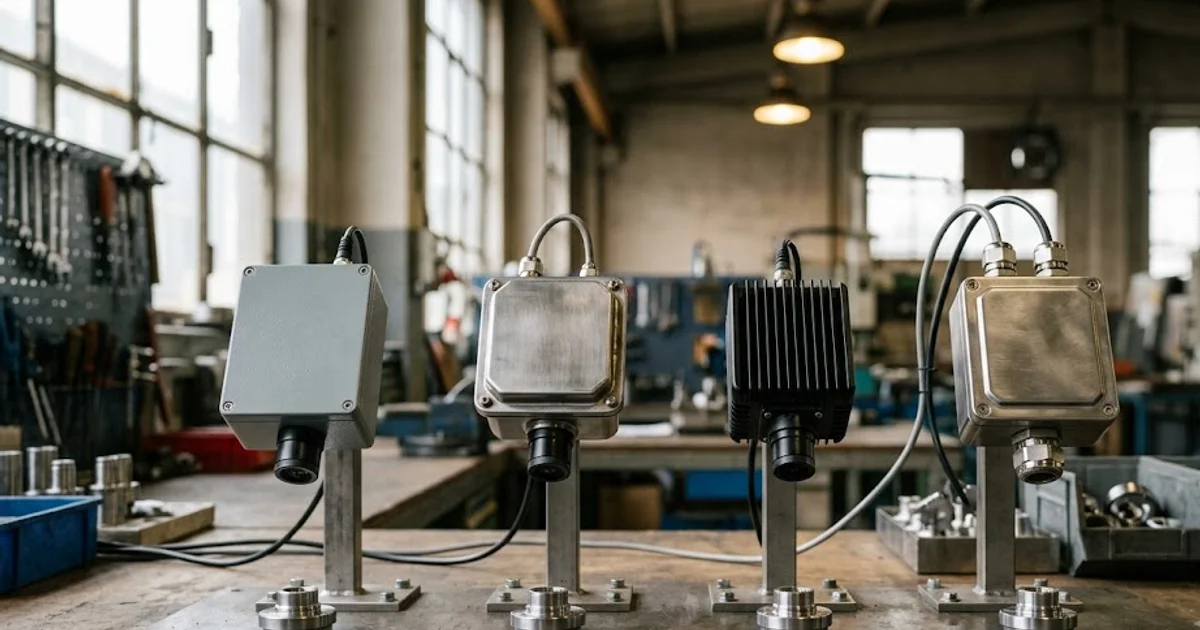
The alternative, a different product family per environment, is expensive in a way that does not show up on a datasheet. Each new family means a new configuration tool, a new set of quirks, a new spare-parts list and a new learning curve, and every one of those multiplies across a portfolio of customers. Consolidating onto one platform collapses that overhead: one thing to stock, one thing to train on, one thing to support. Adente Vision is an edge-AI visual inspection unit built by ADENTE Advanced Engineering Technologies, part of the Aden Group, sold through automation system integrators. It is offered in four enclosure variants that share everything except the shell.
For an integrator, that de-risks the portfolio. A quote for a food line and a quote for a foundry draw on the same integration playbook, the same programming, the same on-device workflow, so the second project is not a fresh engineering exercise. The variable that changes between them is an enclosure rating, not a product you have to relearn.
What stays the same across all four variants?
Across all four variants the optics, the edge compute and the AI inspection modes are identical; only the enclosure changes. The camera and lens, the fanless Jetson-class board, the five inspection modes, the industrial protocols and the installation workflow do not vary by environment, so a model trained and a cell wired on one variant behaves the same on another.
This is the core of the design. The same up-to-12-MP global-shutter optics and the same hybrid of classical computer vision plus AI inference run on every variant, so image quality and decision behaviour are consistent whether the unit sits in a dry assembly cell or a washdown zone. The five modes, Anomaly & Defect Detection, Assembly & Missing Part, Code Reading, Measurement and Part Identification, are present on all four, and the unit installs by the same Mount, Aim, Configure, Wire flow in about 30 minutes regardless of which shell it ships in.
Because only the enclosure is environment-specific, the choice of variant is a facilities decision, not a capability decision. You do not trade away inspection performance to get a washdown or high-temperature rating; you get the same inspection engine in a shell rated for where it has to live.
How do the four variants map to real environments?
Each variant pairs the same inspection engine with an enclosure rated for a specific environment, defined by its IP rating and operating temperature. The IP (ingress protection) rating is set by the international standard IEC 60529, which defines how well an enclosure resists solids and water, so the ratings below are comparable across the industry rather than vendor-specific labels.
| Model | Environment | IP rating | Operating temp | Typical use |
|---|---|---|---|---|
| AV-S100 | Standard industrial | IP54 | 0-45 C | Assembly, machining, packaging |
| AV-W100 | Washdown | IP65 | 0-45 C | Food, beverage, pharmaceutical |
| AV-H100 | High-temperature | IP54 | 0-65 C | Foundries, glass works, hot stamping |
| AV-X100 | Hazardous atmosphere | IP66 | 0-45 C | Chemical and petrochemical |
The mapping is straightforward to apply. A dry assembly or machining cell takes the standard AV-S100 at IP54; a line that gets hosed down for hygiene takes the AV-W100 at IP65; a hot process such as a foundry or glass works takes the AV-H100, which extends the operating range to 0-65 C; and a hazardous atmosphere takes the AV-X100 at IP66. The declared standards for the platform are CE, IP54 and IEC.
How does an integrator pick the right variant?
An integrator picks the variant from two facilities questions, what the enclosure must keep out and how hot the environment runs, because those two properties are the only things that change between models. Everything downstream of the shell, the optics, the compute, the AI modes and the wiring, is constant, so variant selection never involves re-evaluating inspection capability.
Start with ingress. If the line is washed down, water jets rule out IP54 and point to the IP65 AV-W100; a dusty or splash-prone but not washed-down cell is covered by IP54; a hazardous atmosphere with the heaviest ingress demand points to the IP66 AV-X100. Then check temperature: an ambient that can exceed 45 C, near a furnace, a glass works or a hot-stamping press, points to the AV-H100 and its 0-65 C range. Because the two questions are independent of the inspection task, the same part programme and the same trained model move between variants unchanged. For the field workflow that gets any variant from box to first inspected part in about 30 minutes, see the sibling post on installing AI inspection in 30 minutes.
Why does this de-risk an integrator's portfolio?
A one-platform, four-shell line-up de-risks a portfolio because the integrator carries one integration skillset instead of one per environment, so bidding into a new sector does not mean absorbing a new product. The engineering effort of the first project is reusable, which lowers the cost and the uncertainty of the second, third and fourth across different plant conditions.
The commercial effect compounds. One platform means fewer part numbers to stock, one configuration workflow to train staff on, and one support surface to maintain, while still covering standard, washdown, high-temperature and hazardous environments. The integrator quotes with confidence into sectors they have not served before, because the variable is a known enclosure rating rather than an unfamiliar system, and the customer relationship stays with the integrator rather than being handed to a different vendor for each environment.
This post is a spoke of the pillar guide on AI visual inspection. Adente standardises inspection hardware for integrators on one unit family: only the enclosure changes.