Updated July 2026 · 7 min read · Serkan İnkaya · Mechanical Engineer, ODTÜ
Why does a commissioned inspection station drift over time?
An inspection station is accurate the day it launches and then the world around it moves. The model has not changed, but the conditions it learned in do. Lighting output falls slowly as illumination ages, the lens picks up dust and oil mist, ambient light and heat shift by shift and by season, and the parts themselves change as suppliers and batches rotate. Each of these nudges the image away from what the unit was baselined on, and the verdict follows.
Drift is not a fault; it is the normal life of any optical measurement. The point of ownership is to catch it early, while it shows as a slow rise in false rejects rather than as an escape that reaches a customer. Adente Vision is an edge-AI visual inspection unit built by ADENTE Advanced Engineering Technologies, part of the Aden Group, sold through automation system integrators, which means the maintenance model has three hands on it: the operator on the floor, the integrator who commissioned the cell, and Adente upstream.
The good news is that most drift traces to the physical setup, lighting, lens, presentation, not to the model, so most of the upkeep is short and mechanical rather than a data-science task.
What maintenance does a fanless edge unit actually need?
The hardware itself is deliberately low-maintenance. Inference runs on a fanless Jetson-class edge board inside a sealed enclosure, so there is no fan filter to change and no moving part to wear. The enclosure carries an IP rating from IP54 on the standard AV-S100 up to IP66 on the AV-X100, and the unit operates across a 0-45 C range, so on most lines it needs no active cooling and no special environmental housing.
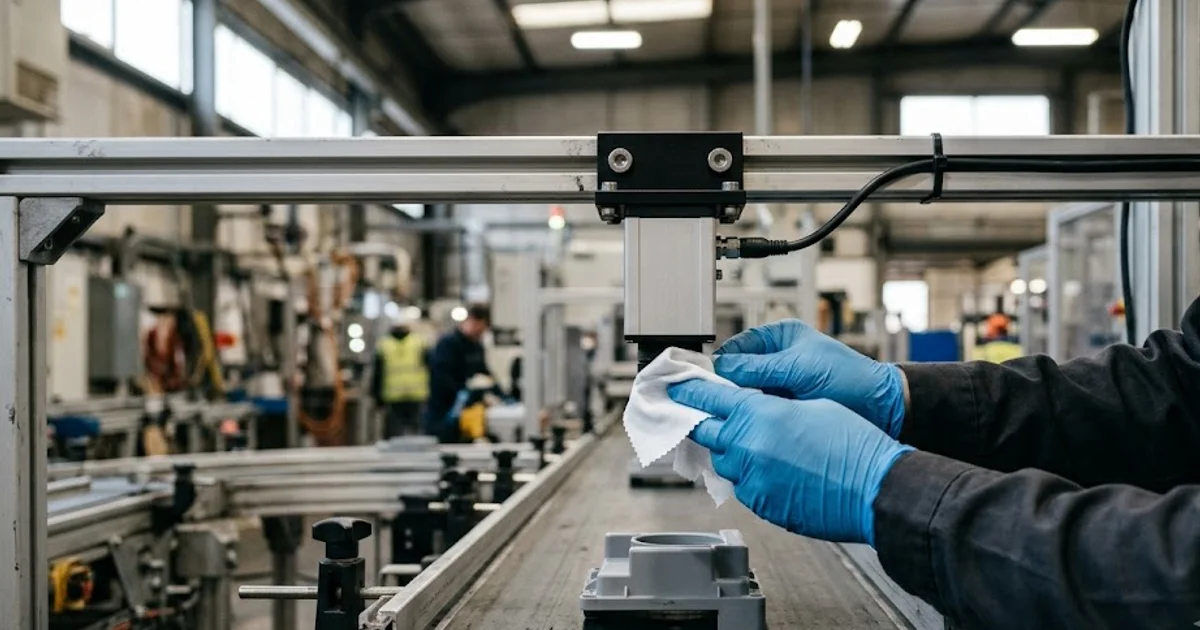
What does need attention is the optical path and the baseline. A practical cadence is: clean the lens and the illumination on a fixed schedule, confirm framing and focus on the on-device preview after any cleaning, and re-check the baseline whenever incoming material changes. Software updates arrive by USB stick, so a unit on an air-gapped line stays current without opening a network path to it. None of this requires a vision engineer on site; it is the kind of routine an operator and a periodic integrator visit can carry between them.
Who owns the unit: operator, integrator or Adente?
Ownership works best as an explicit split rather than an assumption. The operator owns the daily view: reading pass/fail, counts and reject reasons on the web dashboard, cleaning the lens and light on the cadence, and escalating when false rejects climb. The integrator owns the periodic health check: confirming the trigger and lighting, re-baselining after a material change, and retraining when a new defect or a part revision lands. Adente sits upstream, owning the model tooling, the firmware delivered by USB, and support when a case is genuinely new. Whichever hand is on it, the time the station spends stopped belongs on the quality report as inspection availability and its place in OEE, not buried inside a blended line-uptime figure.
The table below maps common drift to who sees it first and what they do about it.
| Drift source | Symptom on the line | Maintenance action |
|---|---|---|
| Lighting output ages | Slow rise in false rejects, dimmer preview | Clean or replace illumination, re-check the on-device preview, re-baseline |
| Lens fouling (dust, oil mist) | Blurred or spotty images, fine defects missed | Clean the lens on the cadence, confirm focus on the preview |
| Ambient change (heat, stray light) | Verdict shifts by shift or by season | Shade stray light, confirm the 0-45 C envelope, keep the IP seal intact |
| Incoming material shift (new batch) | New natural variation reads as a defect | Re-baseline on current good parts, retrain only if truly new |
| Model staleness (new defect, revision) | Escapes rise, a real flaw slips through | Retrain from about 20 images, keep the prior model as a fallback |
How do you tell re-baselining from retraining?
Re-baselining and retraining answer different problems, and confusing them wastes time. Re-baselining resets the reference to the current good parts and lighting without changing what the model knows; it is the right move when the parts are still good but the conditions shifted, a new material batch, a re-lamped fixture, a seasonal light change. It is quick and it is usually the first thing to try when false rejects creep up.
Retraining is for a genuinely new class: a defect the unit has never seen, or a part revision that changes the correct appearance. Here you capture a fresh set of reference images, about 20 good images is enough to start, and the model trains, with training completing under 48 hours in the delivered field cases. Keep the previous model as a fallback so the line can revert if the new one behaves unexpectedly on the first parts. The order to work through is always physical first: lighting, lens, presentation, then re-baseline, and only then retrain.
How do you track that accuracy is holding?
Accuracy holds only if someone is watching the right two numbers. The pair to track over time is the F1-score and the false-negative rate: F1 tells you overall balance, and the false-negative rate is the escape rate, the number that matters most because a missed defect reaches a customer. On the delivered cap-inspection line the unit ran at a 99.65% F1-score and a 0.69% false-negative rate, and the job of maintenance is to keep a running station near its own launch figures, not to hit someone else's.
In practice, log rejects and their reasons from the dashboard, watch the false-reject trend week to week, and treat a sustained rise as the signal to run the diagnostic order above. A short monthly review of these numbers turns drift from a surprise into a scheduled adjustment. For the metric itself, see the post on the false-negative rate; and for the full method, see the pillar guide on AI visual inspection.