27 August 2026 · 7 min read · Mert Aytunur · Mechanical Engineer, University of Illinois Chicago
Many vision vendors lead with accuracy. Far fewer quote their false-negative rate, and that gap is the whole story. Accuracy is the number that looks best on a slide and means the least on a line. If you take one thing from this post, make it a habit: when a vendor says "99% accurate", ask "what's your false-negative rate?" and watch what happens next.
Here is why that question separates a real inspection claim from a marketing one.
Why "accuracy" is a vanity metric
Accuracy is the share of parts the system classifies correctly. It sounds like the right number, but it breaks on exactly the data inspection deals with: imbalanced lines where good parts vastly outnumber defects.
Picture a line running a 1% defect rate. Build the laziest possible "inspector" that passes every single part without looking. It is correct on all 99% of good parts and wrong only on the 1% that are defective, so it scores 99% accuracy while catching zero defects. Every bad part ships. The headline number is excellent and the system is worthless.
That is the accuracy paradox, and it is why a 99% accuracy claim, on its own, tells you nothing about whether an inspection system actually catches defects.
The four metrics that actually matter
To judge an inspection system you need to see how it handles the two ways it can be wrong: missing a defect (false-negative) and rejecting a good part (false-positive). Four numbers cover it.
| Metric | Plain meaning | Why it matters |
|---|---|---|
| False-negative rate | Real defects that pass as good | Escapes reach the customer, the expensive failure |
| False-positive rate | Good parts rejected as bad | Wasted yield, rework, distrust in the system |
| F1-score | Balance of precision and recall | Single figure for overall quality on imbalanced data |
| Cycle time | Milliseconds per part | Must keep up with line speed to be usable |
The F1-score is the one to lead with because it combines precision (of the parts you rejected, how many were truly bad) and recall (of the truly bad parts, how many you caught) into a single number that does not collapse on imbalanced data the way accuracy does. But F1 alone still hides the direction of the errors, which is why you also ask for the false-negative rate specifically.
Why false-negatives are the expensive ones
A false-positive costs you a good part. Annoying, measurable, contained inside the plant: you scrap or rework a part that was fine, and yield drops a little.
A false-negative costs you a bad part that escaped. It ships to the customer, fails in the field, triggers a complaint or a return, and, in regulated or safety-critical work, can pull a whole batch back. One escape can cost more than thousands of unnecessary rejects. That asymmetry is why the false-negative rate is the number a serious buyer protects, and the number worth asking every vendor for explicitly.
This does not mean false-positives are free. A system that rejects 10% of good parts to drive its escape rate to zero is also unusable. The goal is a low false-negative rate and a false-positive rate you can live with, which is exactly what the F1-score, read together with the false-negative rate, tells you.
A worked example with real numbers
Compare three "inspectors" on that same 1%-defect line.
| Inspector | Accuracy | False-negative rate | Useful? |
|---|---|---|---|
| Passes everything | 99.0% | 100% (every defect escapes) | No, catches nothing |
| Rejects on any doubt | ~90% | Near 0% | No, scraps too many good parts |
| A balanced real system | , | Low, disclosed | Yes, if it publishes both |
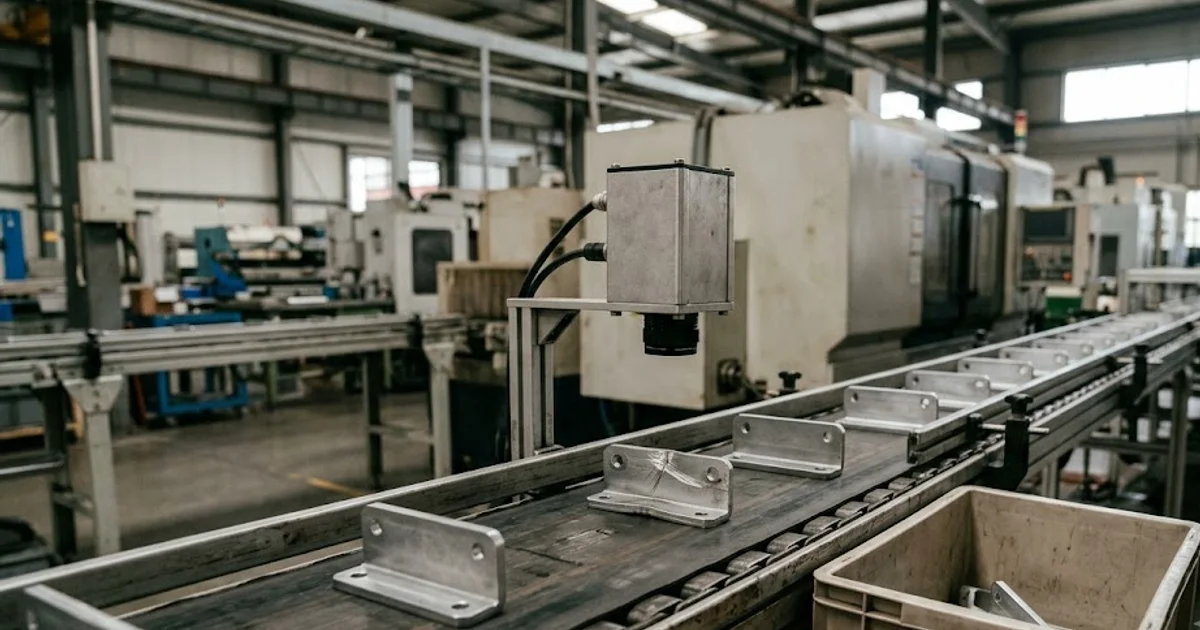
Now a disclosed field result to anchor "good": on a delivered high-speed cap-inspection cell, the system reached a 99.65% F1-score with a 0.69% false-negative rate, at roughly 30 ms per part. Notice what is being reported, not a bare "accuracy" figure, but the F1-score and the false-negative rate together, measured on a real line. And note what the 0.69% counts: the share of truly defective parts that slipped through, not 0.69% of everything produced. That is what a claim you can act on looks like. The cell behind those figures runs cap, label and seal checks on a fast conveyor. (For how these metrics fit into the wider picture, see the AI Visual Inspection guide; the delivered results are on the Applications page.)
What to ask any vision vendor before you buy
You do not need to be a data scientist to pressure-test an accuracy claim. Ask five questions.
- 01What is the false-negative rate, on my part class? The single most revealing question. Vagueness here is a red flag.
- 02What is the F1-score, not just accuracy? If they only quote accuracy, ask why.
- 03On whose parts was this measured, yours or a benchmark? A number on a public dataset like the MVTec Anomaly Detection dataset is not a number on your line.
- 04What false-positive rate does that come with? A great escape rate bought with a 10% reject rate is not a deal.
- 05Will you run it on my sample before quoting? A vendor confident in their numbers will measure them on your part.
A vendor who answers all five plainly is telling you the truth about their system. A vendor who steers back to a headline accuracy figure is telling you something too. Either way, the numbers only count once they survive the move from a pilot cell to a running line.