Updated July 2026 · 6 min read · Mert Aytunur · Mechanical Engineer, University of Illinois Chicago
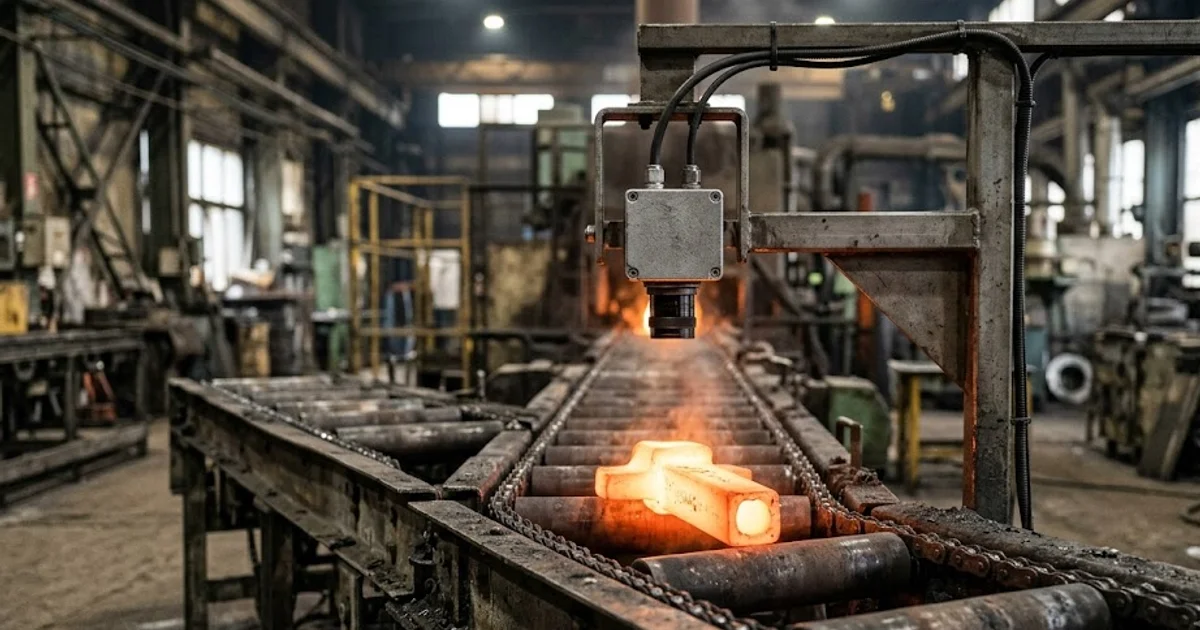
Foundries, glass works and hot-stamping lines defeat most cameras for a reason that has nothing to do with the AI: heat. The air around the station is hot and dusty, and a camera or compute box rated for a normal factory simply cooks or clogs. The instinct to add a cooling fan makes it worse, because a fan pulls the dust straight in.
The fix is an enclosure and a thermal design built for the environment, wrapped around the same inspection platform.
What actually limits a camera near a hot process?
The ambient temperature around the camera, not the temperature of the part, sets the limit. A glowing casting radiates heat into the enclosure, and once the internal temperature exceeds the rating the unit throttles or fails. The AV-H100 answers this by extending the ambient operating range to 0-65 C, against 0-45 C on the standard AV-S100, while keeping the identical optics, Jetson-class edge compute and the five inspection modes. Only the enclosure and thermal design change. The thermal engineering behind that 0-65 C rating, and what it means for standoff distance and shielding, is covered in high-temperature inspection with the AV-H100.
The fanless design is the other half. With no air intake there is nothing to pull hot, gritty air across the electronics, which is why a foundry unit is fanless by choice, not to save cost.
The four variants, by environment
| Model | IP rating | Operating temp | Typical use |
|---|---|---|---|
| AV-S100 | IP54 | 0-45 C | Standard assembly and machining |
| AV-H100 | IP54 | 0-65 C | Foundries, glass works, hot stamping |
| AV-W100 | IP65 | 0-45 C | Food, beverage, pharmaceutical washdown |
| AV-X100 | IP66 | 0-45 C | Chemical and petrochemical (hazardous) |
The table is the whole variant strategy in one view: one platform, four enclosures. An integrator learns the unit once and covers standard, high-temperature, washdown and hazardous environments with the same optics, AI and integration.
What does it inspect, and who installs it?
On a casting or stamped part it runs anomaly detection, a deviation-scoring task benchmarked on public datasets like the MVTec Anomaly Detection dataset, for surface defects and deformation, trained on good parts only, alongside dimensional measurement in millimetres for geometry and position. Inference runs at about 30 ms per part in the field. Adente Vision is an edge-AI visual inspection unit built by ADENTE Advanced Engineering Technologies, part of the Aden Group, sold through automation system integrators, so the integrator who builds your line adds inspection as a line item. This post is a spoke of the pillar guide on AI visual inspection. Because line-speed decisions and hot-line data both stay on the unit, see why line-speed inspection stays on-device, and where it fits across real applications.