Updated July 2026 · 8 min read · Serkan İnkaya · Mechanical Engineer, ODTÜ
Why does ambient temperature, not part temperature, set the camera's limit?
Ambient temperature sets the camera's limit because the camera never touches the hot part, it sees it across a gap. A glowing casting or a hot-stamped blank can be several hundred degrees, but that heat reaches the unit as radiation and hot air, not conduction. What actually constrains the electronics is the air temperature at the mounting point, which is why an operating range is specified as an ambient figure. The standard unit is rated 0-45 C ambient; the AV-H100 raises that to 0-65 C.
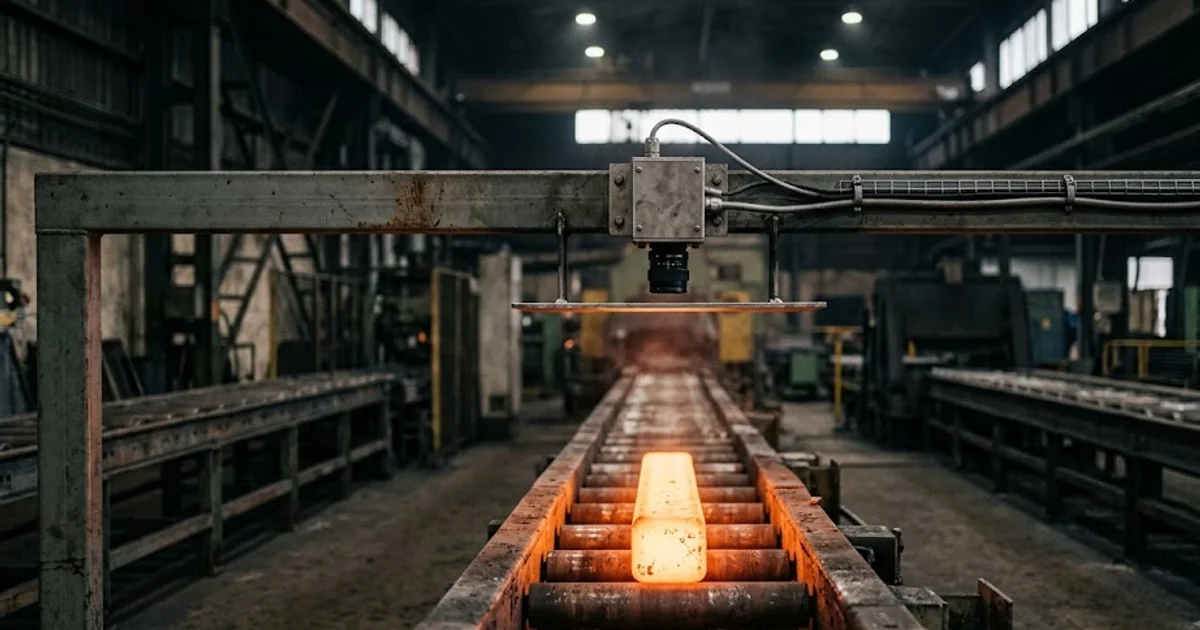
The heat of the part is still a real problem, but it is an optics and lighting problem, not an enclosure-rating problem. A radiant, glowing surface adds glare and its own light to the scene, which is handled with standoff distance, shielding and filtering at the imaging stage, and those are line-engineering choices that apply to any camera near a hot process. The enclosure question is narrower and comes first: can the unit sit in that ambient air and keep running.
Confusing the two leads to the wrong spec. Teams sometimes reject vision near a furnace because the part is hot, when the deciding number is the air at the bracket a metre away. Measure the ambient at the intended mount point across a full cycle, including the peak when a mould opens or a press fires, and compare it to the unit's rated range. That measurement, not the temperature of the part, tells you whether the standard unit fits or the AV-H100 is required.
What does the AV-H100 change versus the standard unit?
The AV-H100 changes one thing: the operating temperature range, from 0-45 C to 0-65 C. Its enclosure is IP54, a rating defined by IEC 60529 and the same seal as the standard AV-S100, because in a foundry or a hot-stamping cell the constraint is heat and dust, not washdown water. It is designed to keep inspecting in the warm ambient air near furnaces, presses and glass lines where a standard unit would run past its rated envelope.
Everything else is held constant. The AV-H100 carries the same up-to-12 MP global-shutter optics, the same fanless Jetson-class edge compute, and the same five inspection modes, Anomaly & Defect Detection, Assembly & Missing Part, Code Reading, Measurement and Part Identification, as the rest of the line. Adente Vision is an edge-AI visual inspection unit built by ADENTE Advanced Engineering Technologies, part of the Aden Group, sold through automation system integrators, and the high-temperature variant is the same inspection engine in a housing rated for a hotter room.
That parity is the point of the variant family. A model developed against the standard optics and compute transfers to the AV-H100 without re-engineering the vision, so a foundry can adopt the same inspection approach used elsewhere in the plant and only change the unit that has to survive the heat.
Why is a fanless design an advantage in hot, dusty air?
A fanless design is an advantage in hot, dusty air because a fan pulls that air, and its grit, straight through the unit. Foundry, glass and hot-stamping environments carry fine particulate, sand, scale and mould release, and a forced-air cooler turns the enclosure into a filter that clogs and eventually fails. The AV-H100 runs on a fanless Jetson-class board and cools passively, so there is no intake path dragging abrasive dust across the electronics.
Passive cooling also pairs with the IP54 seal in a consistent way. A dust-protected housing is undermined by a fan that has to breathe, so removing the fan keeps the sealing story intact: the unit does not need to move external air to stay within temperature. In a dirty, hot cell, fewer moving parts and no air intake is what keeps the unit running between maintenance windows rather than becoming another thing to clean.
The trade is that passive cooling has a ceiling, which is exactly why the ambient rating matters. The 0-65 C figure is the envelope within which the fanless design holds, so the sizing task is to confirm the ambient at the mount stays inside it across the cycle. Inside that range, fanless is the more reliable choice for the environment; outside it, the mounting position or local shielding has to bring the ambient back down.
What can it inspect near foundry, glass and hot-stamping stations?
Near foundry, glass and hot-stamping stations the unit runs surface, geometry and position checks with the same five modes it uses elsewhere. Anomaly & Defect Detection learns a good part and flags deviation, which suits casting and forming surfaces where defects vary and are hard to describe with a fixed rule, and it also classifies known defects. Measurement checks feature position and dimensions per part in millimetres. The line-side view of that work, what actually gets checked at a casting or press station and where the unit mounts, is set out in foundry and hot-stamping inspection.
| Spec | AV-S100 (standard) | AV-H100 (high-temperature) |
|---|---|---|
| Operating temperature | 0-45 C | 0-65 C |
| Enclosure rating | IP54 | IP54 |
| Cooling | Fanless | Fanless |
| Optics and sensor | Up to 12 MP global shutter | Identical |
| Edge compute and AI | Jetson-class, five modes | Identical |
| Typical line | Assembly, machining, packaging | Foundry, glass, hot stamping |
Position and dimensional work is a documented strength: the unit outputs feature coordinates and measurements in millimetres per part, which is the basis for a positioning check. In R&D at a leading glass manufacturer, the approach is applied to glass positioning, locating the part so a downstream step acts on it correctly. Surface-defect and deformation scope on castings and formed parts varies by process, so the achievable result on a specific check is an application-specific measurement rather than a transferred figure, but the mode coverage and the mm-level geometry output are the same tools used across the plant.
How do you confirm it fits your hot line?
You confirm it by measuring the ambient air at the exact mount point across a full cycle, then matching it to the rated range. If the peak ambient stays within 0-65 C, the AV-H100 fits directly. If it runs hotter at the intended position, the practical moves are to step the unit back, add a heat shield, or relocate to a cooler sightline, all standard line-engineering measures for a camera near a hot process.
The inspection proof, as always, comes from your parts. The glass-positioning work and the millimetre geometry case show the method, but the number you can commit to for a casting-surface or hot-stamping check is the one measured on your parts, your lighting and your cycle. Because the model trains on good parts only, from about 20 reference images with training under 48 hours, that trial is a short capture-and-train task rather than a long data project. For when to reach for learned AI versus a fixed rule on a hot line, see the sibling post on rule-based vs AI machine vision; for the wider method, the AI visual inspection guide; and for high-temperature deployments, the applications page.