22 October 2026 · 6 min read · Mert Aytunur · Mechanical Engineer, University of Illinois Chicago
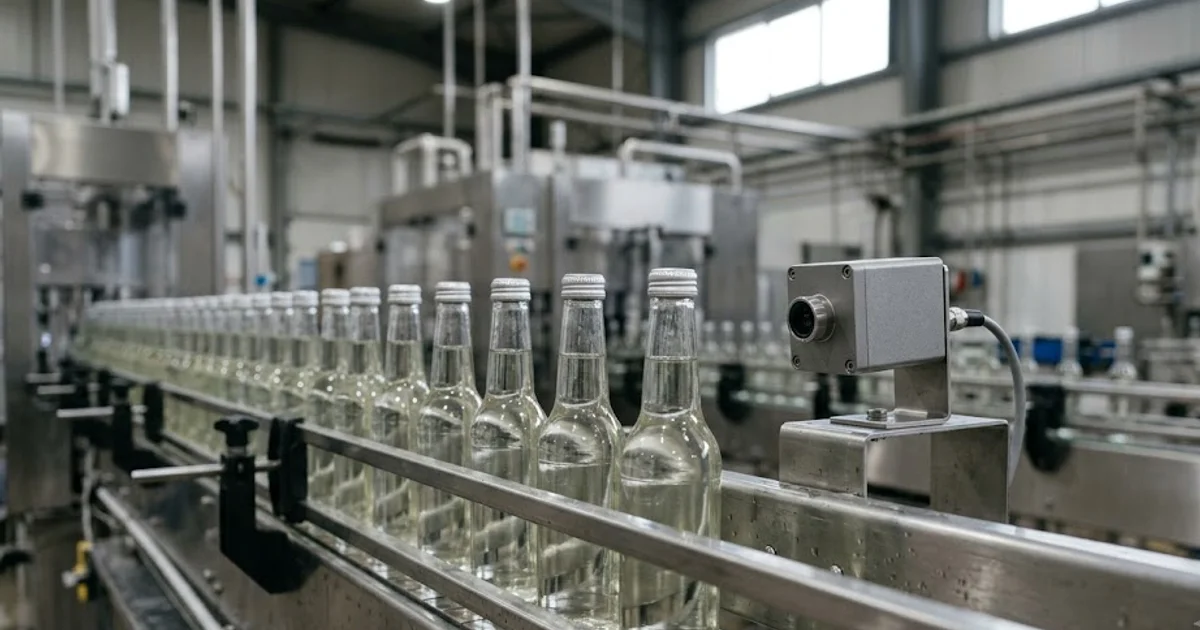
A food or beverage line has two problems most vision pitches skip. The first is the defect that escapes: a broken, unclosed or hinge-damaged cap that ships and becomes a customer complaint or a recall. The second is the environment: the line gets hosed down, and a camera that was never sealed for it fails within weeks. Both have to be solved together, or neither is solved.
The proof that they can be starts with a real deployment.
What has AI cap inspection actually achieved?
On a live cap-inspection line, an Adente Vision unit rejects broken, unclosed and hinge-damaged caps as they pass, in real time. The measured result is a 99.65% F1-score with a 0.69% false-negative rate at about 30 ms per part. The false-negative rate is the number that matters: it is the escape rate, the fraction of bad caps that get through, and 0.69% is the figure to hold any vendor to.
| Metric | Value | Context |
|---|---|---|
| F1-score | 99.65% | On a live cap-inspection line |
| False-negative rate | 0.69% | The escape rate, the expensive error |
| Time per part | ~30 ms | Measured in the field |
| Throughput | 100+ parts/min | Catalog bound, not a measured guarantee |
| Training set | 20 good images | Trained on good parts only, model in under 48 h |
For why the false-negative rate, not headline accuracy, is the honest inspection metric, see the inspection metric vendors don't advertise.
Why does a washdown line need the AV-W100?
A standard IP54 enclosure keeps out dust and light splashing, and it is fine for a dry assembly cell. It is not built for the daily hose-down a food, beverage or pharmaceutical line gets. The AV-W100 is the washdown variant: IP65, 0-45 C, sealed against water jets, running the identical camera, lighting, Jetson-class edge compute and the same five inspection modes as the standard unit. Only the enclosure changes, so the AI you validate is the AI that survives cleaning. The pharmaceutical side of the same enclosure question, where the checks are blister completeness, seal integrity and batch marking, is covered in pharmaceutical packaging inspection with AI.
Choosing the wrong rating is the most common and most expensive mistake on these lines. Matching the IEC 60529 IP54, IP65 and IP66 ratings to the environment is worth getting right before anything else.
What else runs on the same unit?
The cap is one check. Fill level, label placement and print, seal presence and foreign-object anomalies run on the same platform, because Anomaly & Defect Detection, Assembly & Missing Part, Code Reading, Measurement and Part Identification are the five inspection modes of one unit rather than five systems to buy and wire. The unit triggers from a photoelectric sensor or the line encoder and drives a reject through its 24V outputs, keeping up with a catalog bound of 100+ parts per minute.
Adente Vision is an edge-AI visual inspection unit built by ADENTE Advanced Engineering Technologies, part of the Aden Group, sold through automation system integrators. For a food or beverage plant that means the integrator who builds your filling and capping lines can add inspection as a line item, and the image data never leaves your premises. This post is a spoke of the pillar guide on AI visual inspection; see where it fits across real applications.