Updated July 2026 · 7 min read · Serkan İnkaya · Mechanical Engineer, ODTÜ
Why is a standard IP54 camera the wrong choice for a washdown line?
A standard IP54 camera is the wrong choice for a washdown line because IP54 is only rated against splashing water, and a washdown is a directed jet. Food, beverage and pharmaceutical lines are cleaned between runs with detergents, foam and pressurised water aimed straight at the equipment. Under IEC 60529, the second IP digit tells you what the housing survives: a 4 covers splashing from any direction, a 5 covers water jets from a nozzle. A washdown crosses that line every shift.
Dust matters too. The first IP digit on an IP54 unit is a 5, meaning dust-protected but not dust-tight, so fine ingress is possible. On a hygienic line that is scrubbed and rinsed, you want the housing fully sealed, which is the step from a 5 to a 6 in the first digit. IP65 delivers both: dust-tight sealing and water-jet resistance, which is exactly the pair a washdown environment demands. The authoritative test definitions are published in IEC 60529.
Get this wrong and the failure is not subtle. Water past the seal reaches the sensor, the lens mount and the edge board, and the unit stops inspecting. On a food or pharma line, an inspection outage is also a quality-record gap, so the enclosure rating is a food-safety and traceability decision, not only a hardware one.
What does the AV-W100 add for washdown environments?
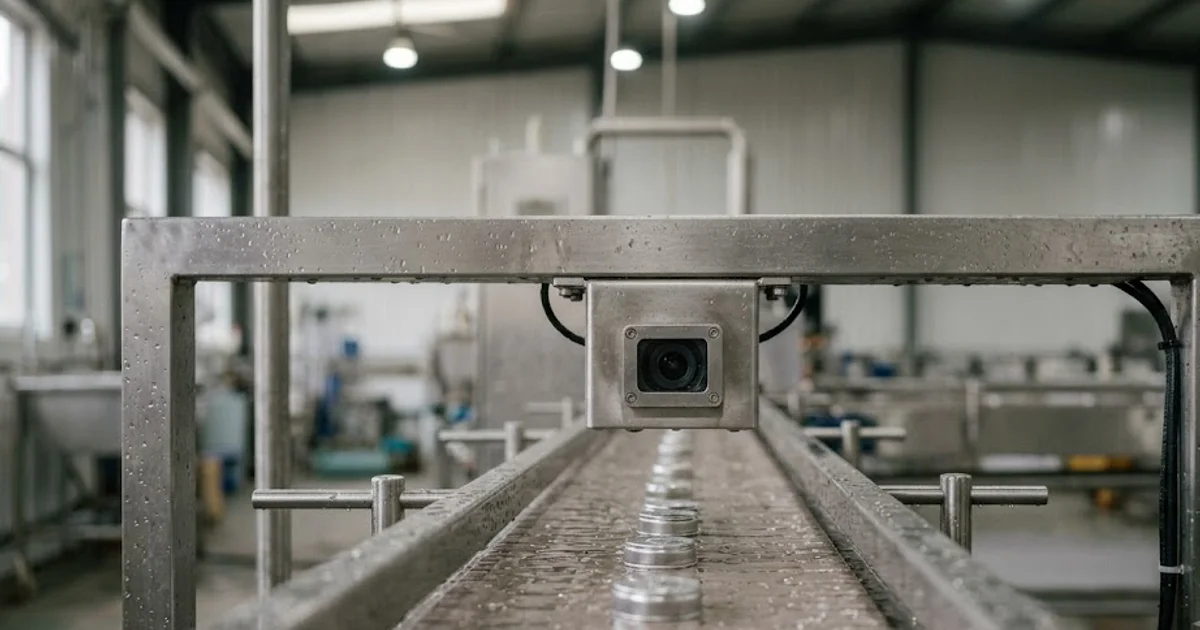
The AV-W100 is the washdown variant: IP65-rated, dust-tight and resistant to water jets, with a 0-45 C operating range for food, beverage and pharmaceutical cells. It is built to sit on a line that gets hosed down between runs and keep inspecting, where a standard IP54 unit would take on water at the first cleaning cycle.
Only the enclosure changes. The AV-W100 carries the same up-to-12 MP global-shutter optics, the same fanless Jetson-class edge compute, and the same five inspection modes as the standard AV-S100. You are not trading inspection capability for the seal, which means an integrator can specify the washdown housing and the same AI in one quote.
| Washdown demand | Standard IP54 (AV-S100) | AV-W100 (IP65) |
|---|---|---|
| Directed water jets | Not rated, splash only | Rated to IP65 water jets |
| Dust ingress | Protected, not dust-tight | Dust-tight |
| Detergent and foam wipe-down | Ingress risk at the seam | Sealed housing |
| Operating temperature | 0-45 C | 0-45 C |
| Optics, compute and AI | 12 MP, Jetson-class, five modes | Identical |
What can it inspect on a food, beverage or pharma line?
On a food, beverage or pharma line the unit runs the same five modes it runs anywhere, Anomaly & Defect Detection, Assembly & Missing Part, Code Reading, Measurement and Part Identification, applied to closures, fill, labels and foreign material. Cap and closure integrity is a common washdown-line check: on a live cap-inspection installation, the unit rejects broken, unclosed and hinge-damaged caps in real time. That is the field case behind the headline numbers.
On that cap line the measured result was a 99.65% F1-score with a 0.69% false-negative rate at about 30 ms per part, with model training completing in under 48 hours. The false-negative rate is the number a food or pharma quality manager watches most closely, because it is the escape rate, the share of bad parts that slip through. A 0.69% false-negative rate on a live line is the kind of concrete, checkable figure that a hygiene-critical process needs, rather than a general accuracy claim.
Fill level, label placement, seal presence, date and lot coding, and foreign-object screening are the other checks that recur on hygienic lines. These map onto the same five modes, though the achievable result on any specific check depends on the part, the lighting and the defect, and needs an application-specific measurement rather than a transferred number. The unit combines classical computer vision for measurement with AI inference for judgement, so a result is auditable rather than a black box, which matters when the record has to stand up to an audit.
How does the AV-W100 support pharma traceability and data control?
The AV-W100 supports traceability by deciding on the unit and keeping the images there. Inference runs on the fanless Jetson-class board inside the enclosure, so each part gets a pass/fail decision on the line, and raw part imagery does not have to leave the plant to be judged. Adente Vision is an edge-AI visual inspection unit built by ADENTE Advanced Engineering Technologies, part of the Aden Group, sold through automation system integrators, and on-device decision-making is one reason it fits regulated, data-sensitive lines.
Per-part results carry to the controller over the protocol the cell already speaks, PROFINET, EtherNet/IP, Modbus TCP, EtherCAT or OPC UA, with 4 inputs and 4 outputs at 24V for triggering and reject actuation. A web-based dashboard exposes live status without a separate PC on the line. For an air-gapped pharmaceutical cell, model updates load from a USB stick, so the unit never needs a network path off the plant floor.
That combination, an on-device decision, a per-part record over a standard protocol, and updates that arrive by USB, is what lets a washdown line keep a complete, checkable quality trail without shipping sensitive product imagery to a cloud. For a quality manager, the traceability story and the data-control story are the same story.
How do you size and prove it for your line?
You prove it on your own parts, because the honest answer for a new check is a measurement, not a borrowed number. The cap line result of 99.65% F1 is real and checkable, but it belongs to that installation. For your closure, fill or label check, the figure that matters is the one measured on your parts under your lighting, which is why the process starts with samples rather than a spec sheet promise.
The data requirement is small to get going. The model trains on good parts only, so a working model can start from about 20 reference images rather than a defect catalogue, and training completes in under 48 hours. For a food or pharma line adding a new SKU or a new closure, that turns a change into a short capture-and-train task instead of a data-collection project. For the full method behind few-shot and anomaly detection, see the sibling post on inspecting with 20 images, and for the wider context the AI visual inspection guide. Washdown deployments across food, beverage and pharma are described on the applications page.