Updated July 2026 · 7 min read · Mert Aytunur · Mechanical Engineer, University of Illinois Chicago
Two constraints define inspection on a pharmaceutical packaging line. The packaging faults that matter, a missing blister cavity, a compromised tamper-evident seal, a wrong batch or date code, are rare and varied, so you can never collect enough examples of each to train a supervised system. And the data is sensitive: many regulated plants restrict where process imagery is allowed to travel. A cloud-first vision pitch struggles with both.
An edge unit that learns from good packs and keeps images on the line answers both at once.
What can it check on a blister or carton line?
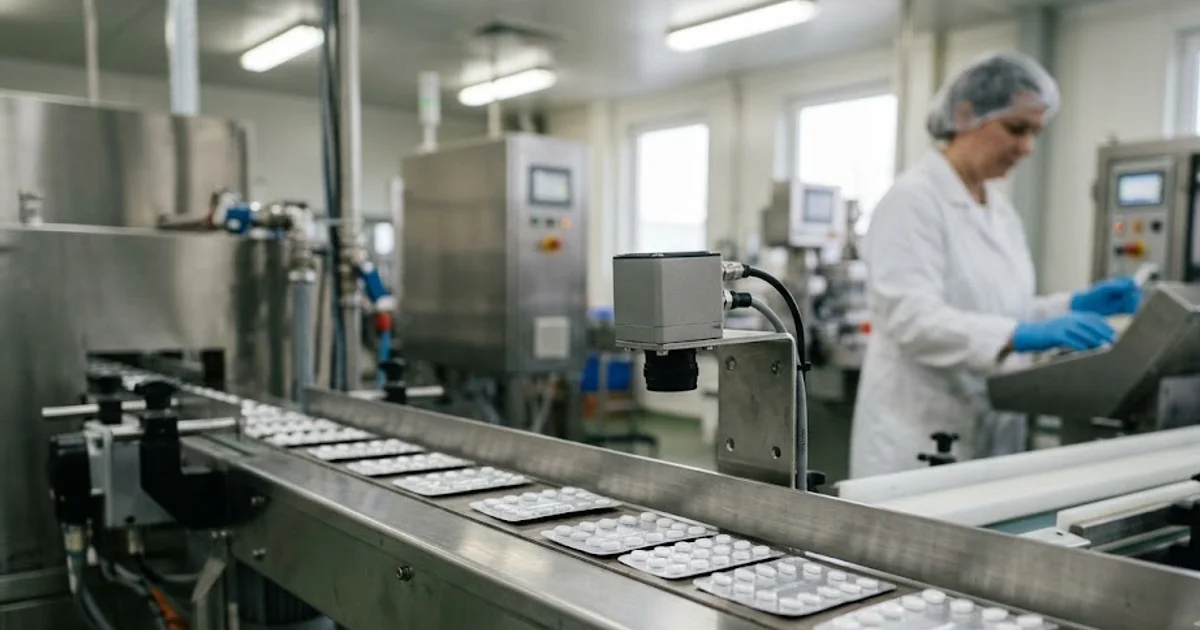
Trained on good packs only, the model builds a picture of a correct pack: every cavity filled, the seal intact, the right batch and date printed. It then scores each pack by how far it deviates, so a missing tablet, a poorly sealed edge or a misprinted code is flagged even if that exact failure was never in the training set. Because it rejects by deviation rather than by matching a known defect, it covers the long tail of rare packaging faults that a labelled-defect approach never sees enough of.
| Check | Inspection mode | Variant |
|---|---|---|
| Blister completeness | Defect / assembly verification | AV-W100 (IP65) washdown |
| Tamper-evident seal | Anomaly, trained on good packs | AV-W100 (IP65) washdown |
| Batch and label / date code | Recognition and print verification | AV-W100 (IP65) washdown |
| Rare packaging fault | Anomaly, deviation from good | AV-W100 (IP65) washdown |
| Foreign object in pack | Anomaly, first-seen coverage | AV-W100 (IP65) washdown |
Why does the image staying on the line matter here?
Inference runs on a fanless Jetson-class board inside the enclosure. The pack is classified locally, the pass/fail is emitted to the PLC, and no imagery is uploaded. For a regulated plant that narrows the data-handling surface: the picture of your product and process never leaves the premises. This is an architecture choice, not a compliance guarantee, and your own quality team owns the validation. For the wider case on why line-speed inspection stays on-device, see edge vs cloud visual inspection.
The same property makes the unit workable on an air-gapped line. It needs no outbound connection to run, and a retrained model is deployed by USB stick, so a tightly segmented pharmaceutical cell can still improve its inspection over time without opening a network path.
Which unit, and who installs it?
The AV-W100 (IP65 to IEC 60529, 0-45 C) is the washdown variant for food, beverage and pharmaceutical lines. It runs the identical optics, edge compute and five inspection modes as the standard unit, in a sealed enclosure that survives cleaning. Adente Vision is an edge-AI visual inspection unit built by ADENTE Advanced Engineering Technologies, part of the Aden Group, sold through automation system integrators, so the integrator who builds your packaging line adds inspection as a line item and keeps the account. How that line item is written, the protocols, the power drop and the variant choice, is set out in specifying an edge-AI inspection unit into an automation quote. This post is a spoke of the pillar guide on AI visual inspection; see where it fits across real applications.