19 October 2026 · 8 min read · Mert Aytunur · Mechanical Engineer, University of Illinois Chicago
Most vision problems are about spotting a defect. On a busy electronics line the harder problem comes first: the mix of boards changes faster than any fixed program can keep up with. That is where learning a good board, rather than describing every fault, starts to pay off.
Why does high-mix PCB assembly break a fixed AOI program?
Rule-based automated optical inspection (AOI) is programmed board by board. An engineer defines where each component sits, what a good solder joint looks like, and the tolerance for each feature, then tunes the program until false rejects settle. On a stable, high-volume board that pays off. The trouble starts with high-mix, small-batch production, where a line runs many board types in short runs and a new revision lands before the last program is tuned. Every new board is another programming job, and a fault nobody anticipated has no rule to catch it.
That is the gap AI anomaly detection fills. Instead of a rule per feature, the model learns what a good board looks like from examples and flags anything that deviates, so it catches first-seen faults a rule was never written for. Adente Vision is an edge-AI visual inspection unit built by ADENTE Advanced Engineering Technologies, part of the Aden Group, sold through automation system integrators, and anomaly detection is one of five inspection modes it runs on the line. The two approaches stay complementary: keep AOI for the known, measurable checks it does well, and add anomaly detection for the high-mix boards and the rare faults that slip past a fixed program.
How does AI anomaly detection catch a solder fault it was never programmed for?
Anomaly detection scores how far a part strays from good rather than matching it to a catalogue of named defects, a task benchmarked on public datasets like the MVTec Anomaly Detection dataset. The model builds a picture of a correct board from good examples, then rates each new board by deviation. A solder bridge, an insufficient or cold joint, tombstoning, a shifted part: each reads as a departure from the learned normal and crosses the anomaly threshold, even the first time that exact fault appears. Because the model trains on good parts only, about 20 good reference boards are enough to begin and training completes under 48 hours, which turns a new revision into a two-day task rather than a multi-month data-collection project. Which 20 boards you pick matters more than adding more of them, because on a set that small data quality beats data quantity, and a single mis-lit or quietly defective board shifts the learned normal.
One honesty point on speed: the measured field result is about 30 ms per part and the catalog bound is 0.5 s per part at 100+ parts per minute. Treat those as the envelope, not a promise. The figure you can commit to for a specific board and lighting setup needs an application-specific measurement on your own line. For the full method behind learning a part from a handful of good boards, see the pillar guide to AI visual inspection.
Can it verify missing components and wrong orientation from good boards only?
Presence, absence and orientation are recognition checks the unit learns from correct boards, so it does not need a catalogue of every wrong build. It learns what a fully populated, correctly oriented board looks like, then flags a missing connector, an absent capacitor, a rotated or reversed part as a deviation, with a per-part confidence you can act on. Above the threshold the board passes; below it, the board routes to a safe default for a second look rather than being forced into a class, so a suspect board is diverted before it reaches reflow or final test. For how few-shot training from a handful of good parts works, see how to inspect a part with only 20 images.
Where do rule-based AOI and AI anomaly detection each win?
Neither approach replaces the other on an electronics line. Rule-based AOI is the faster, more repeatable choice for stable, specified checks; AI anomaly detection covers the high-mix boards and the unknown faults a fixed program cannot describe. The table below sets out where each earns its place.
| Dimension | Rule-based AOI | AI anomaly detection |
|---|---|---|
| Inspects best | Known, specified features and measurements | First-seen and cosmetic deviations no rule describes |
| Setup per board | A program written and tuned feature by feature | About 20 good boards, model ready under 48 hours |
| High-mix, small-batch | A new program for every board and revision | Learns each good board, retrains from 20 images |
| Rare or novel faults | Missed when no rule exists for them | Flagged as a deviation from good |
| Best role on the line | Fast, repeatable checks on stable boards | Complementary cover for high-mix and unknown faults |
In practice a plant adds the AI stage to an existing AOI station incrementally, keeping the deterministic checks it already trusts and layering learned cover on top, rather than replacing a working line.
What optics and lighting does shiny solder need?
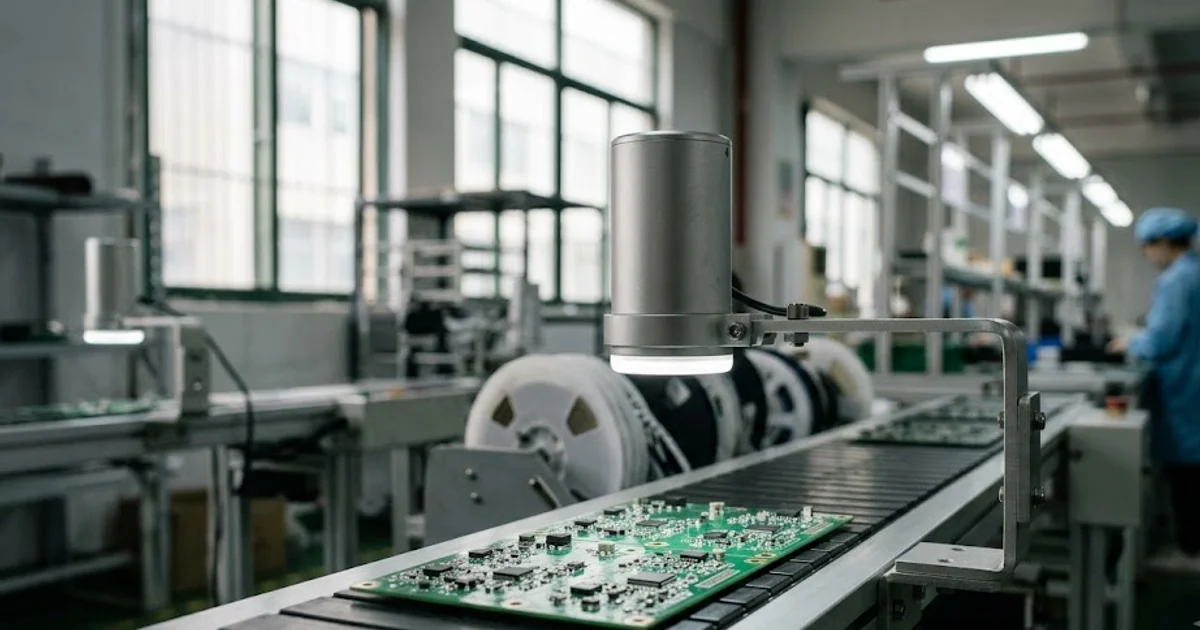
Solder is specular, so the image depends on lighting geometry more than on the model. A bright, mirror-like joint under the wrong light either blooms into glare or hides a void, and no amount of training recovers detail the camera never captured. The unit carries a camera of up to 12 MP with a global shutter and a C-mount lens, so a moving board is frozen without smear and small features stay resolvable. Lighting is configurable in colour and angle across diffuse, directional and coaxial geometries at 24V: coaxial light suits flat, specular solder and pads, directional low-angle light raises scratches and lifted leads, and diffuse light evens out matte and curved surfaces. An on-device preview lets one person set the light and framing on the line during the Aim step, so lighting is dialled in where the board actually runs rather than at a bench.
How does the AV-S100 wire into an electronics line?
The AV-S100 is the standard-industrial unit (IP54, 0-45 C) for a dry electronics assembly or packaging cell, and it drops in without a separate PC or a cloud dependency. It carries pass/fail and coded results over the five industrial protocols it speaks (PROFINET, EtherNet/IP, Modbus TCP, EtherCAT or OPC UA), with 4 inputs and 4 outputs at 24V for discrete signalling and reject actuation. Inference runs on a fanless Jetson-class board (8-16 GB) inside the enclosure, which is what makes per-part decisions at line speed possible without a fan drawing dust into the cell.
The unit weighs under 9 kg and mounts in about 30 minutes by one person. Every board image is processed on the unit, so raw imagery, which for a contract manufacturer is sensitive customer IP, never leaves the line. See where the AV-S100 fits across real system hardware, or add AI inspection alongside the AOI you already run.