Updated July 2026 · 6 min read · Serkan İnkaya · Mechanical Engineer, ODTÜ
What does OCR, barcode and label verification mean in machine vision?
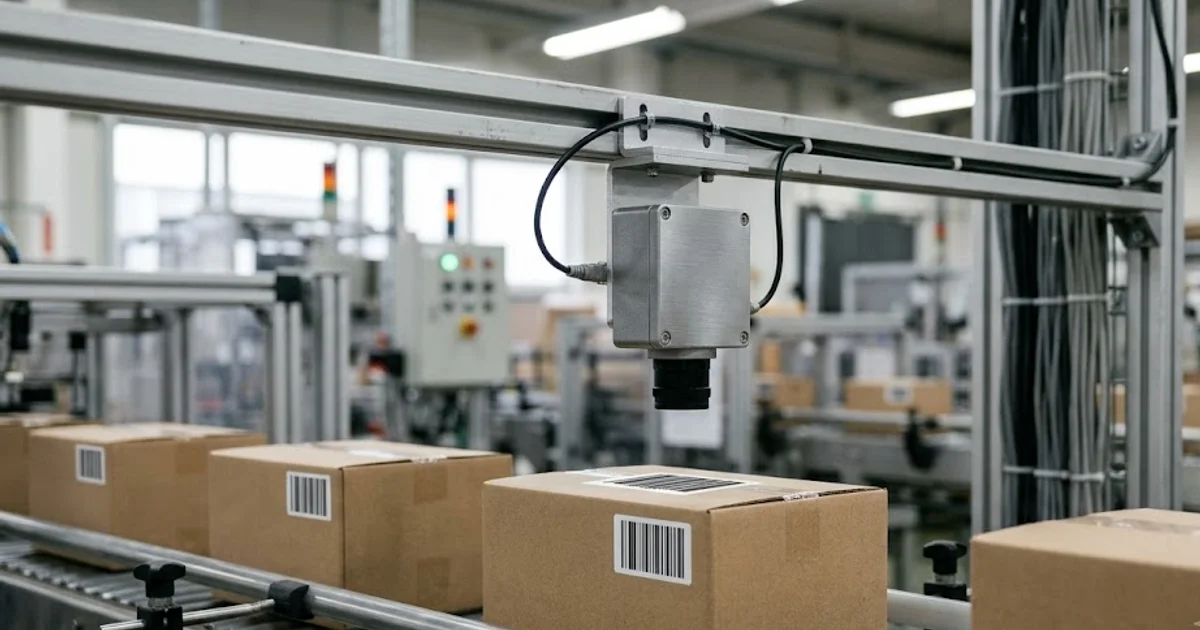
OCR, barcode and label verification is the family of inspection checks that confirm the right identifying marks are present and correct on a part or its packaging. It covers four common jobs: reading a barcode or data-matrix symbol, reading human-readable text with optical character recognition (OCR), confirming a date, lot or batch code carries the expected value, and checking that the correct label is present and printed cleanly.
These checks answer a different question from defect detection. Defect inspection asks "is this part physically good," while verification asks "is this the right part, with the right code and the right label." A part can be flawless and still fail verification because it carries yesterday's date code or the wrong regional label, and that failure can be as costly as a physical defect when it reaches a regulated market.
The distinction matters when you scope an inspection station, because the reading tasks and the judgment tasks are handled by different halves of a vision system.
How do hybrid vision systems read and verify labels and codes?
Hybrid vision systems split verification between classical computer vision and an AI layer, the same division they use for the rest of an inspection. Classical CV is the reader. Decoding a barcode or data matrix, and reading fixed characters under stable lighting, are deterministic tasks with published symbologies and grading standards, so a rule-based decoder does them fast and exactly, and returns a clean match or no-match.
The AI layer is the judge. Where the print is degraded, the label can shift or wrinkle, or the surface varies, a learned model is better at deciding whether the result is acceptable than a brittle rule. Trained on good labels, it flags a smear, a missing character, a misaligned or wrong label as a deviation from what a correct one looks like, even when the exact fault was never specified in advance. This is the same anomaly logic, a deviation-scoring approach benchmarked on public datasets like the MVTec Anomaly Detection dataset, that catches first-seen physical defects, applied to print and labelling.
The output of either half reaches the line as a signal a controller understands: a match or no-match, a correct or incorrect string, or a pass or fail with a reason. For the wider decision of which checks suit rule-based reading and which suit AI judgment, see the sibling guide on rule-based vs AI machine vision.
What verification checks map to which method?
Read the table as the general split in hybrid vision, not as a fixed feature list for any one unit. Which specific checks a given system supports should be confirmed against its datasheet.
| Verification check | How vision handles it | Line output |
|---|---|---|
| Barcode / data-matrix read | Classical CV decodes the symbol | Match or no-match to the PLC |
| Human-readable text (OCR) | Classical CV or AI reads characters | Correct or incorrect string |
| Date / lot / batch code | Reader extracts, logic checks the value | Pass or fail on the expected value |
| Correct label present | AI compares to a known-good label | Pass or fail plus a reason |
| Print quality (smear, missing ink) | AI flags deviation from good print | Anomaly flag, reject signal |
What can Adente Vision confirm for label and print checks?
Here is the honest footing. Adente Vision is an edge-AI visual inspection unit built by ADENTE Advanced Engineering Technologies, part of the Aden Group, sold through automation system integrators. Its confirmed strengths sit on the judgment side of verification rather than on a documented barcode or OCR reader.
The unit combines classical computer vision with AI inference in one enclosure and runs five inspection modes: Anomaly & Defect Detection, Assembly & Missing Part, Code Reading, Measurement and Part Identification. Its anomaly approach trains on good examples and flags deviation, which is exactly the mechanism that catches a misprint, a smeared code, a missing character or the wrong label: you show it a good label or a clean print, and it flags what does not match. Variant and part recognition return a per-part confidence score, the same score described in the companion post on confidence scores and decision thresholds. All of this runs on-device, so raw imagery of the label and part stays on the line.
What is not documented as an Adente product fact is a dedicated barcode decoder or an OCR engine reading a specific character set. So do not assume it reads your data matrix or your date-code font out of the box.
How do you confirm a specific OCR or barcode task is supported?
Confirm it two ways before you design it in. First, check the current datasheet for your application: the specific symbologies, character sets, code standards and print-grading behaviour a unit supports belong on the spec sheet, and that is the document to verify against, not a blog post. Second, send a sample. The most reliable check is to put your actual part, label and lighting in front of the unit and see the result, because print verification is sensitive to contrast, gloss, curvature and lighting in ways a spec line cannot fully capture.
This is also the honest way to scope any verification station. A barcode read on flat, high-contrast stock under controlled light is a solved, deterministic task for classical vision. A worn date code on a curved, reflective surface is a harder judgment where the AI layer helps but where you should prove the result on your own samples first.
This post is a spoke of the pillar guide on AI visual inspection; to see the checks the unit runs across sectors, browse the real applications.