Updated July 2026 · 6 min read · Serkan İnkaya · Mechanical Engineer, ODTÜ
Why does the trigger method decide whether you catch the part?
The trigger is what tells the camera the exact moment to capture, and getting it wrong means the part is half out of frame, blurred, or missed entirely. A good trigger fires once per part, at the same position every time, so the model always sees the part in the same pose. That repeatability matters more than the trigger technology itself, because a model trained on consistently framed images is a model that stays accurate on the line.
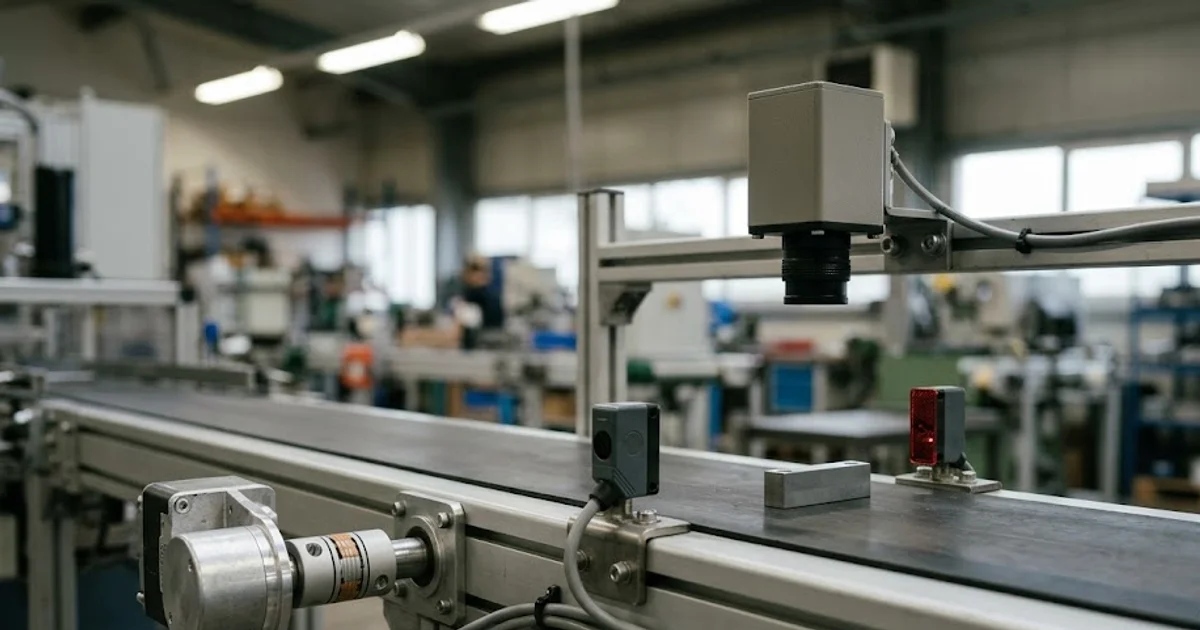
The three practical sources are an encoder pulse, a photoelectric sensor, and a fixed interval, and the unit supports all three. Which one fits depends on how the part moves past the camera: continuously on a belt, stepping through an indexed station, or arriving at a steady rate. Adente Vision is an edge-AI visual inspection unit built by ADENTE Advanced Engineering Technologies, part of the Aden Group, sold through automation system integrators. It locks capture to the part rather than to a wall-clock timer, so the image stays repeatable regardless of line speed.
When should you trigger from an encoder pulse?
An encoder pulse is the right trigger for a continuous conveyor, where the part never stops and you need capture locked to position rather than time. The encoder counts the belt's travel, so the camera fires at the same physical point for every part no matter how the line speed drifts, which keeps framing constant even as the conveyor speeds up or slows down.
Position-locked capture is also what lets throughput scale cleanly. Because the trigger is tied to travel, the capture rate follows the line automatically, up to catalog throughput of 100+ parts per minute, and the ~30 ms measured inference field result leaves headroom between parts at most conveyor speeds. Pairing the encoder with the global shutter is what freezes the part cleanly, which the last section covers.
When is a photoelectric sensor the better trigger?
A photoelectric sensor is the simplest and most common trigger when parts arrive one at a time with gaps between them. The sensor detects the leading edge of the part as it breaks the beam and fires a single capture, so you get a part-present trigger with no position tracking. It is the natural choice on pick-and-place feeds, indexed carriers, and any line where each part announces itself.
A photoelectric trigger is cheap, easy to align, and independent of line speed, but it fires on presence, not position, so a part that jitters or rotates as it passes can arrive slightly differently each time. Where pose repeatability is critical, an encoder gives tighter position control; where parts are well-separated and consistently presented, the photoelectric edge trigger is usually all you need. The unit accepts the sensor directly on a 24V input.
Which trigger fits which line?
Match the trigger to how the part moves past the camera. Continuous conveyors want an encoder; discrete part-present feeds want a photoelectric sensor; indexed or slow stations where the part is stationary during capture can use a fixed interval. The table maps each source to the line it suits and what it locks the capture to.
| Trigger source | Best-fit line | What it locks capture to |
|---|---|---|
| Encoder pulse | Continuous conveyor | Belt position, constant framing at any speed |
| Photoelectric sensor | Part-present, well-separated parts | The part's leading edge |
| Fixed interval | Indexed or slow, part stationary at capture | A steady time base set to the cycle |
| Encoder plus photoelectric | Fast conveyor needing both gate and position | Part presence gated to belt position |
How does the trigger interact with the global shutter and jitter?
A trigger only sets when the camera captures; the shutter decides how cleanly it freezes a moving part. The unit uses a 12 MP global-shutter sensor, the class of imager characterized under the EMVA 1288 standard, which exposes every pixel at the same instant, so a part crossing the frame is captured without the skew a rolling shutter introduces. That is what lets an encoder or photoelectric trigger work at speed: the trigger picks the moment, and the global shutter freezes it.
Trigger jitter, the small variation in when the capture actually fires after the event, matters most at high speed, because a fast part travels a visible distance during even a millisecond of slack. A hardware trigger from an encoder or photoelectric sensor keeps that jitter low, and the global shutter freezes whatever motion remains, so the defect stays sharp. A fixed-interval trigger has more timing slack, which is why it suits slower or stationary-capture stations rather than a fast belt. To match the trigger rate to throughput, size it to the catalog 100+ parts per minute and confirm the real rate with an application-specific measurement on your line.
This post is a spoke of the pillar guide on AI visual inspection; for the method that trains a model from about 20 good parts, see few-shot anomaly inspection, and to see how the unit locks capture to the part, browse the system overview.