Updated July 2026 · 7 min read · Mert Aytunur · Mechanical Engineer, University of Illinois Chicago
What do the two digits in an IP rating actually mean?
An IP rating is a two-digit code defined by IEC 60529, and the two digits are read separately: the first is protection against solids and dust, the second is protection against water. IP65 is not "bigger than" IP54 on one scale. It says the enclosure is dust-tight (first digit 6) and rated against water jets (second digit 5), where IP54 is only dust-protected (5) and splash-resistant (4).
The first digit runs from 0 to 6. A 5 means dust-protected: dust can enter, but not in a quantity that harms the electronics. A 6 means dust-tight: no ingress at all. That step from 5 to 6 is the difference between a camera that tolerates a dusty aisle and one sealed against fine airborne particulate.
The second digit describes liquid ingress. A 4 covers splashing water from any direction. A 5 covers water jets projected from a nozzle. A 6 covers high-pressure water jets, the kind a cleaning crew aims at a machine during a washdown. Each step assumes the one below it, so an IP66 enclosure also passes the lower splash and jet tests. The authoritative definitions live in IEC 60529, the international standard for ingress protection.
Why does the enclosure, not the AI, fail first in the wrong environment?
The enclosure fails before the model does because water and dust attack the camera and edge compute long before they reach the inspection logic. An anomaly model does not care whether the aisle is dusty or the line gets hosed down at shift change. The sensor, the lens and the board inside the housing do, and once moisture or grit gets past the seal, the unit is dead regardless of how good the AI is.
Matching the rating to the plant is therefore an environment decision, not an accuracy decision. A dry assembly cell and a food line running a hot-water washdown demand different enclosures for the same inspection job. Over-specifying wastes money on a seal you never use; under-specifying puts the whole unit at risk on the first cleaning cycle. The rating is the part of the spec that decides whether the hardware survives your plant, so it is worth getting right before anything else.
How do IP54, IP65 and IP66 map to the four Adente Vision variants?
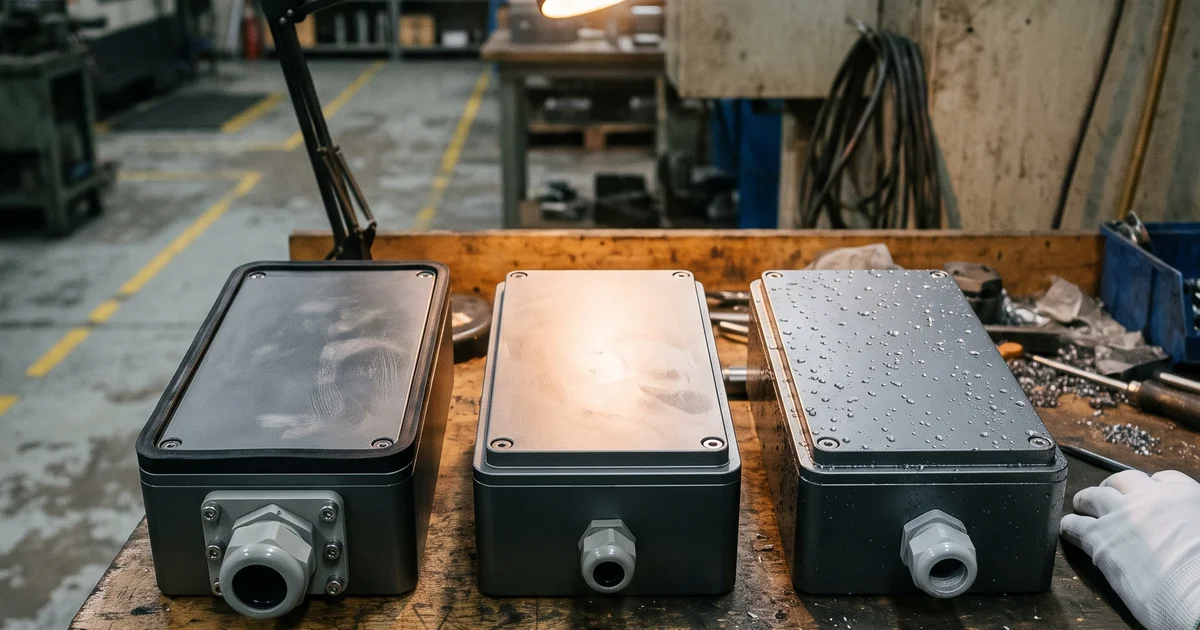
Adente Vision ships four enclosure variants that map directly onto the IP grades, so the environment picks the variant. The standard AV-S100 is IP54 for dry work, the AV-W100 is IP65 for washdown, and the AV-X100 is IP66 for the harshest cells. The AV-H100 shares the IP54 seal of the standard unit but raises the operating temperature range for hot environments.
| Variant | IP rating | Environment | Typical line |
|---|---|---|---|
| AV-S100 | IP54 | Standard, dry | Assembly, machining, packaging |
| AV-W100 | IP65 | Washdown | Food, beverage, pharmaceutical |
| AV-H100 | IP54 | High-temperature | Foundry, glass, hot stamping |
| AV-X100 | IP66 | Hazardous atmosphere | Chemical, petrochemical |
The AV-H100 row is the reminder that IP is only one axis. Its seal matches the AV-S100 at IP54, but its operating envelope reaches 0-65 C rather than the 0-45 C of the other variants, because in a foundry the constraint is ambient heat, not water. Declared standards across the line are CE, IP54 and IEC, and what each of those marks does and does not promise is unpacked in reading the CE, IP and IEC marks on an inspection datasheet. For hazardous-atmosphere certification on the AV-X100, confirm the specific ATEX or IECEx marking against the datasheet for your zone rather than assuming it from the IP grade.
Does a higher IP rating change how the inspection performs?
A higher IP rating does not change inspection performance, because only the enclosure changes between variants. The optics, the edge compute and the AI are the same across all four. Every variant carries the same up-to-12 MP global-shutter sensor, the same fanless Jetson-class board, and the same five inspection modes: Anomaly & Defect Detection, Assembly & Missing Part, Code Reading, Measurement and Part Identification. You are choosing a seal, not a different inspection engine.
That is deliberate. Adente Vision is an edge-AI visual inspection unit built by ADENTE Advanced Engineering Technologies, part of the Aden Group, sold through automation system integrators, and keeping the internals identical means an integrator can quote the same inspection capability into a dry cell or a washdown cell and only vary the housing. A model trained for one line moves to the equivalently rated unit on another line without re-engineering the vision, because the sensor and compute it was trained against are unchanged.
The practical consequence is that the rating question is separable from the accuracy question. Decide what the environment demands first, IP54, IP65 or IP66, then specify the inspection modes and integration on top. Neither decision constrains the other, which is why the four-variant map is a menu rather than a set of performance tiers.
How do you choose the right rating for your line?
Start from the worst thing that regularly touches the unit, not the average condition. A cell that is dry most of the week but gets a directed water jet every Friday is a washdown environment for rating purposes, so it needs IP65, not IP54. The rating has to survive the peak exposure, because a single failed seal ends the deployment.
For a dry assembly, machining or packaging cell with normal airborne dust and the occasional splash, IP54 and the AV-S100 are the right fit. For food, beverage and pharmaceutical lines cleaned with detergents and water jets, step up to the IP65 AV-W100, which is dust-tight and jet-rated. For chemical and petrochemical cells that see high-pressure hosing and demand a dust-tight, sealed housing, the IP66 AV-X100 is the target, with hazardous-area certification verified per zone. And where the challenge is heat rather than liquid, the AV-H100 keeps IP54 but extends the temperature range.
If you are unsure which grade your cell actually demands, describe the environment, the cleaning regime, the ambient temperature and the dust load, and we map it to a variant before quoting. For the broader method behind on-device inspection, see the AI Visual Inspection guide, and for why we keep decisions on the unit rather than in the cloud, see edge vs cloud visual inspection. The variant hardware itself is described on the Adente Vision system page.