Updated July 2026 · 7 min read · Serkan İnkaya · Mechanical Engineer, ODTÜ
What does a raw part image actually reveal about your operation?
A raw inspection frame is not a neutral snapshot; it is a detailed record of how you make a part. One high-resolution image can carry the part geometry, the fixture and tooling in the background, the surface finish, the print or label content, and, frame after frame, the throughput and defect rates of the line. For an OEM or a contract manufacturer under NDA, that is exactly the information a customer expects to stay inside the plant.
So the data-residency question is not abstract. When an inspection tool uploads frames to a vendor cloud for processing, the most sensitive picture of your operation leaves the building and lands in someone else's storage, in a region and under a contract you may not fully control. Keeping inspection images inside the factory is the difference between classifying a part locally and handing a third party a continuous stream of your production IP.
How does on-device inference keep the image on the line?
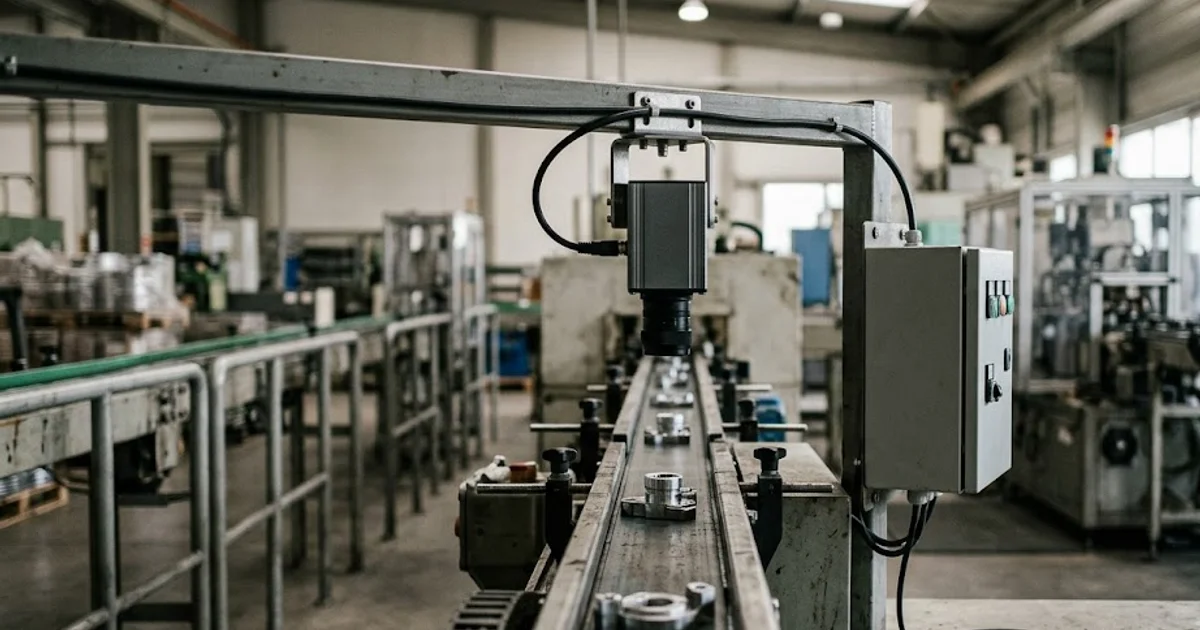
On-device inference keeps the image on the line by doing all the work where the picture is taken. Adente Vision is an edge-AI visual inspection unit built by ADENTE Advanced Engineering Technologies, part of the Aden Group, sold through automation system integrators. It captures, analyses and decides each part inside one enclosure. The camera feeds a fanless Jetson-class board with 8-16 GB, the model runs there, and the output that leaves the unit is a pass or fail signal, not the frame.
The timing shows why nothing needs to be uploaded. The local decision takes about 30 ms per part, well inside a fast index cycle, so there is no reason to send the image anywhere to meet the budget. The raw frame is processed and can be discarded on the line; only the verdict, and any counts you choose to keep, moves on. Every step, capture, inference and the pass/fail to your PLC, happens on your side of the plant boundary.
What is data residency, and why does it matter for factory imagery?
Data residency is the question of where your data physically lives and is processed. For factory imagery it decides who can hold, copy or subpoena the pictures of your parts, and which jurisdiction's rules apply to them. A cloud inspection pipeline puts that answer outside your walls; an on-device unit keeps it at the machine.
Residency matters for three concrete reasons on a production line. First, IP: the frame is a blueprint of your part and process, and once it is uploaded you no longer solely control copies of it. Second, customer contracts: many OEM and defense agreements require that imagery of their parts never leave the supplier's premises, which a cloud pipeline cannot honour. Third, jurisdiction: a frame sent to a data centre abroad may fall under that region's transfer and disclosure rules, a compliance surface an on-premises decision never creates. Where personal data can appear in the frame, that surface grows again, which the sibling post on GDPR and factory imagery covers as an architecture question.
What data leaves the line: cloud vision vs an on-device unit?
The useful way to compare the two architectures is to list what actually crosses the plant boundary in each. In a cloud pipeline the raw frame is the payload; in an on-device unit the payload is a decision.
| Data | Cloud vision | On-device edge unit |
|---|---|---|
| Raw part image | Uploaded and stored off-site | Processed on the line, not shipped off-site |
| Part geometry and tooling detail | Exposed inside every uploaded frame | Stays inside the factory |
| Throughput and defect rates | Inferable from the image stream | Kept as local metrics only |
| Pass/fail decision | Returned from the cloud | Emitted on-device in about 30 ms |
| Aggregate counts (optional) | Bundled with the raw frames | Shared as numbers, frames stay down |
The bottom row is the important one. Choosing the edge does not mean giving up cross-line visibility; it means separating the numbers you want to centralise from the frames you do not. Counts, rates and drift can travel; the images that encode your process do not have to move at all.
Can you still get fleet analytics without shipping raw frames?
Yes. Fleet analytics needs metrics, not pictures. Each unit decides locally and can report counts, pass/fail rates, cycle times and drift to a web-based dashboard, so a quality manager sees trends across several lines while every raw frame stays on the unit that captured it. The dashboard aggregates numbers; it does not build a central lake of your part images. Which metrics travel, and how the dashboard is fed without a frame ever leaving the cell, is set out in fleet analytics without shipping raw frames.
The governance rule is to move the smallest thing that answers the question. A trend line needs a defect count, not the defect image. When someone genuinely needs to look at a specific part, you can pull a few samples deliberately and log that you did, rather than streaming everything by default. That keeps the analytics useful and the imagery resident, and it gives plant IT a clean, short answer to the residency questions in any vendor review: where are the images processed, where are they stored, and what leaves the line.
This post is a spoke of the pillar guide on AI visual inspection; to see how the camera, edge compute and AI sit in one enclosure that keeps the image on the line, browse the system.