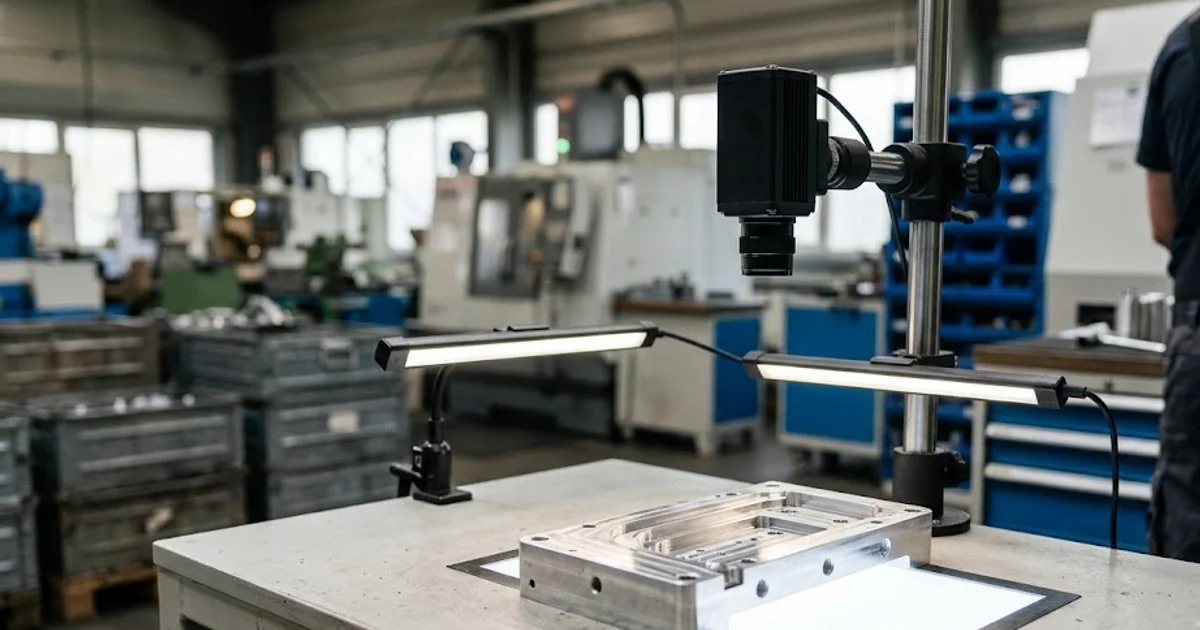
Updated July 2026 · 7 min read · Serkan İnkaya · Mechanical Engineer, ODTÜ
What is hybrid machine vision?
Hybrid machine vision is an inspection design that runs two methods on the same part: classical computer vision for the parts of the check that can be measured with a fixed rule, and an AI model for the parts that call for learned judgment. It is not a marketing label for "some AI inside." It is a division of labour, chosen so that each half does what it is genuinely good at, and so that the whole system stays explainable.
The reason to combine them is that neither method covers a real inspection alone. Classical computer vision is exact and deterministic but blind to anything a rule did not describe. A deep-learning model generalises to variation and rare defects but is harder to interrogate when it says no. Put them together and the deterministic half handles the measurable checks while the learned half handles the judgment calls, and every result can be traced back to one or the other.
Adente Vision is an edge-AI visual inspection unit built by ADENTE Advanced Engineering Technologies, part of the Aden Group, sold through automation system integrators, and its inspection engine is hybrid by design: classical computer vision combined with AI inference, not a single opaque network.
What does classical computer vision do well?
Classical computer vision follows explicit, hand-written instructions: find this edge, measure this distance, count these features, compare this pixel value to a threshold. Because the logic is written down, it is fast, repeatable and easy to validate. When a part fails, you can point to the exact measurement that failed and by how much.
That makes classical CV the right half of the hybrid for anything metric. Dimensional gauging is the clearest example: on a real line, an inspection unit can report feature coordinates and dimensional measurement per part in millimetres, a number a quality engineer can check against a drawing tolerance. Counting is the same story, so is confirming that a feature sits inside a defined position window. These checks do not need a neural network, and forcing them through one would only remove the audit trail that makes them trustworthy.
The limit of classical CV is variation and the unknown. A rule tuned for stable lighting drifts when line speed changes the exposure. A rule written for one variant fails on the next. And a rule can only catch a defect that someone was able to describe in advance, so it is blind to the first-seen flaw nobody specified.
What does the AI layer add?
The AI layer learns the appearance of a good part from example images instead of from hand-written rules. That single difference is what lets it cover the cases classical CV cannot: natural surface variation, complex textures, and defects that never look the same twice.
Its strongest contribution is anomaly detection. Trained on good parts only, the model builds a picture of normal and flags anything that deviates, which means it can catch a rare or first-seen defect that no rule was written for, the good-parts-only task public benchmarks such as the MVTec Anomaly Detection dataset are built to measure. Because it trains on good samples, a working model can begin from a small set of reference images rather than a catalogue of every possible defect, which is what makes adding a new part a short task rather than a data-collection project. The AI layer also handles variant classification, returning a per-part confidence score the cell can act on rather than a brittle rule that breaks on the next variant.
The trade the AI layer brings is interpretability: a learned score is less self-explanatory than an explicit measurement. That is exactly why it is paired with classical CV rather than used alone.
How do classical CV and AI split the work?
Read the table as the general division of labour between the two families. The hybrid result is not one method winning, it is each check routed to the half that does it best.
| Inspection task | Classical CV role | AI layer role |
|---|---|---|
| Dimensional gauging (position, size in mm) | Measures the feature deterministically | Rarely needed |
| Feature or part counting | Counts by explicit rule | Resolves overlap and clutter |
| Position and presence on a fixtured part | Checks against a defined window | Tolerates natural variation |
| Surface defect (scratch, dent) | Misses undefined flaws | Flags deviation from a good part |
| Rare, first-seen anomaly | No rule can catch it | Learns normal, flags the rest |
| Variant classification | Brittle across variants | Classifies with per-part confidence |
Why is a hybrid system more auditable than a black box?
A hybrid system is auditable because most of its pass or fail decisions trace to something a person can inspect. The metric checks resolve to numbers with units, so a rejected part comes with the measurement and the tolerance it broke. The learned checks resolve to a confidence or anomaly score against a threshold you set, so a rejected surface comes with a score and the operating point that failed it. Neither answer is "the network decided."
This matters on a production line for two practical reasons. First, quality audits and customer complaints need a reason, and "the measured gap was 2.4 mm against a 2.0 mm limit" is a reason a supplier and a customer can both act on. Second, when false rejects creep up, a hybrid system lets you see whether the drift is in a measurement or in a learned score, which tells you whether to adjust a fixture or retrain the model.
Adente Vision keeps this structure on-device. Its five inspection modes, Anomaly & Defect Detection, Assembly & Missing Part, Code Reading, Measurement and Part Identification, run the same hybrid split, so measurement and learned judgment are both available on the same part without sending the image off the line to a separate service.
How does Adente Vision implement the hybrid approach?
The confirmed footing is straightforward. The unit combines classical computer vision with AI inference in one enclosure, runs the five modes above, and reports dimensional measurement per part in millimetres for the metric checks. The AI half trains on good parts to flag deviation, and variant recognition returns a per-part confidence score rather than a hard rule. All of it runs at the edge, so raw part imagery stays on the line.
For where hybrid fits against a purely rule-based station, and how to decide which check belongs to which method, see the sibling decision guide on rule-based vs AI machine vision. For the threshold that turns a learned score into a pass or fail signal, see the companion post on confidence scores and decision thresholds. For the full method behind few-shot and anomaly detection, see the pillar guide.