Updated July 2026 · 7 min read · Serkan İnkaya · Mechanical Engineer, ODTÜ
What is the difference between a global shutter and a rolling shutter?
A camera sensor turns light into a picture, but not every sensor captures the whole frame at the same instant. A rolling shutter exposes and reads the sensor one row at a time, top to bottom, so the bottom of the frame is captured a fraction of a second after the top. A global shutter exposes every pixel simultaneously and then reads them out, so the whole frame belongs to one moment in time.
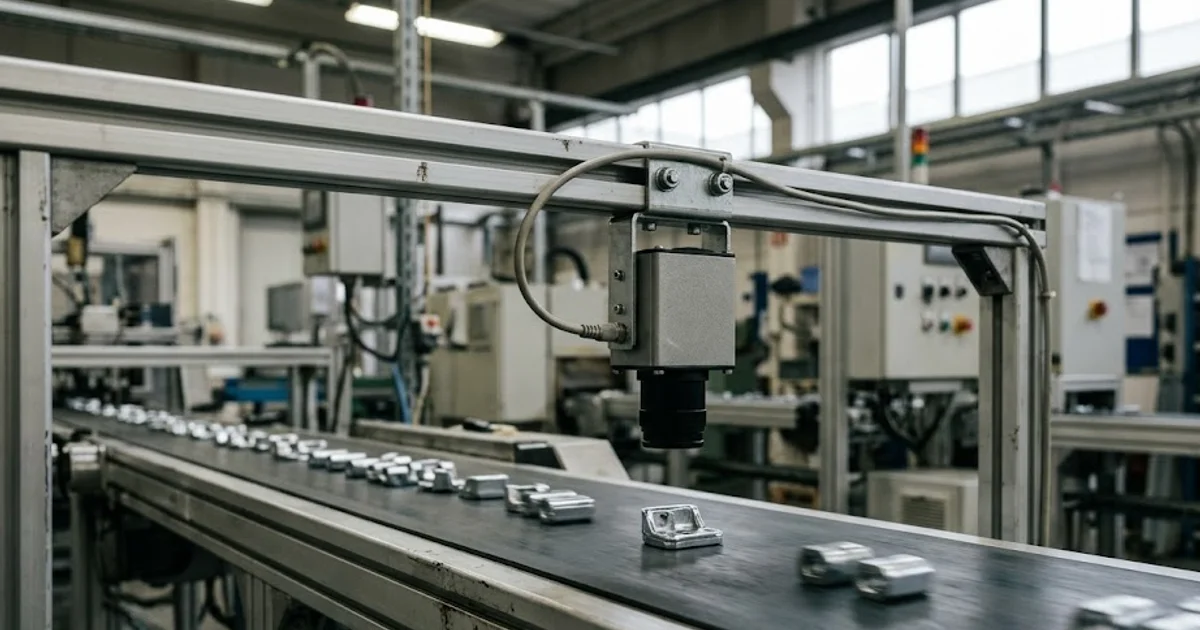
For a static scene the difference is invisible. For a part travelling past the camera on a conveyor or an index table, it decides whether the image is usable. This is general imaging physics, not a claim specific to any one camera, and it is the reason machine-vision cameras aimed at moving parts almost always use a global shutter. Adente Vision is an edge-AI visual inspection unit built by ADENTE Advanced Engineering Technologies, part of the Aden Group, sold through automation system integrators, and its camera uses an up-to-12-MP global-shutter, C-mount sensor for exactly this reason.
Why does a rolling shutter smear a moving part?
While a rolling shutter is still reading its lower rows, a fast-moving part has already advanced. The result is skew: straight edges lean, circles turn into ovals, and a feature near the bottom of the frame sits in a different place than it would have if the whole frame were captured at once. If the exposure is also long relative to the motion, you get motion blur on top of the skew. Either way, the geometry the AI receives no longer matches the real part.
That distortion is fatal for two kinds of inspection. Dimensional and position checks depend on the geometry being faithful, so a skewed frame measures the wrong distance. Fine surface-defect detection depends on sharp local contrast, and blur spreads a scratch or a pore across several pixels until the model can no longer separate it from the background. A global shutter removes the skew by construction, because there is no row-to-row time offset to begin with, and it lets you pair a short exposure or a strobe with the capture to stop the remaining blur.
| Property | Rolling shutter | Global shutter |
|---|---|---|
| Exposure timing | Row by row, top to bottom | Every pixel at the same instant |
| Fast-moving part | Skew, and blur if exposure is long | Frozen and geometrically correct |
| Strobe or flash lighting | Banding risk if timing is off | Even exposure across the frame |
| Typical home | Consumer and phone cameras | Industrial machine vision |
| Best fit | Static or slow scenes | Parts in motion at line speed |
Why does 12 MP resolution matter, and where does it stop helping?
Resolution sets how many pixels cover your part, and that decides the smallest feature the camera can resolve before the AI even looks. As general imaging physics, the pixel footprint on the part is the field of view divided by the pixel count along that axis. A wider field of view spreads the same pixels over more millimetres, so each pixel covers a larger patch and the smallest resolvable defect grows. More megapixels buy back that detail: an up-to-12-MP sensor, an imager of the class characterized under the EMVA 1288 standard, puts more pixels across the same field of view than a lower-count sensor, so a small scratch or a fine edge lands on enough pixels to be seen.
There is a point where more megapixels stop helping. A defect has to produce contrast against its background for any number of pixels to matter, and if the lens is not sharp enough, or the focus or the lighting is wrong, extra resolution just records a blurrier version of nothing. Bigger images also cost more to move and process per part, which matters when the cycle is tight. The practical rule is to size resolution to the smallest defect and the field of view you actually need, then spend the rest of the budget on optics and lighting. Picking the lens that carries that detail is its own exercise, worked through in the post on C-mount lens selection for machine vision.
How does global shutter pair with triggering at line speed?
A frozen frame is only useful if it is captured at the right moment, so the sensor works with the trigger, not on a free-running timer. The unit triggers off an encoder pulse, a photoelectric sensor or a fixed interval, which locks the capture to the part rather than to the clock. On a fast index or conveyor, the encoder tells the camera exactly when the part is in the field of view, the global shutter takes the whole frame in one instant, and a short exposure or strobe stops the motion inside that instant.
On throughput, treat the numbers as an envelope. The catalog bound is 100+ parts per minute, and the measured field result on a live cap-inspection line is about 30 ms per part. The number you can commit to for your own line depends on your part, your lighting and your optics, so it needs an application-specific measurement rather than a figure lifted from a datasheet. What the global shutter guarantees is that whatever rate you run, each captured frame is a faithful snapshot rather than a smeared one. For how few good images it then takes to train the model on those frames, see the sibling post on inspecting with 20 images. For where the sensor sits in the whole unit, see the system overview, and for the full method, see the pillar guide on AI visual inspection.