10 September 2026 · 8 min read · Mert Aytunur · Mechanical Engineer, University of Illinois Chicago
Why does transparent and coated glass defeat ordinary machine vision?
Glass is the hardest surface a vision system can be asked to locate because it barely presents an image to work with. Light passes straight through a clear panel instead of bouncing back, so a standard camera and fixed lamp see the background behind the glass, not the glass edge. Contrast between the part and everything behind it collapses, and an ordinary edge-finding routine loses the boundary it needs to report a position.
Coatings make the task harder, not easier. Low-emissivity and other functional coatings change how the surface reflects across the spectrum, so a face that reads one way under one lamp reads differently under another, and a specular reflection turns into glare that washes out the very edge the robot is reaching for. For a handling cell the question is rarely "is there a defect on this glass." It is the more basic and more difficult one: exactly where is the edge and the face, in millimetres, so a robot can pick the panel without cracking it.
How did the glass-positioning R&D project locate a near-invisible panel?
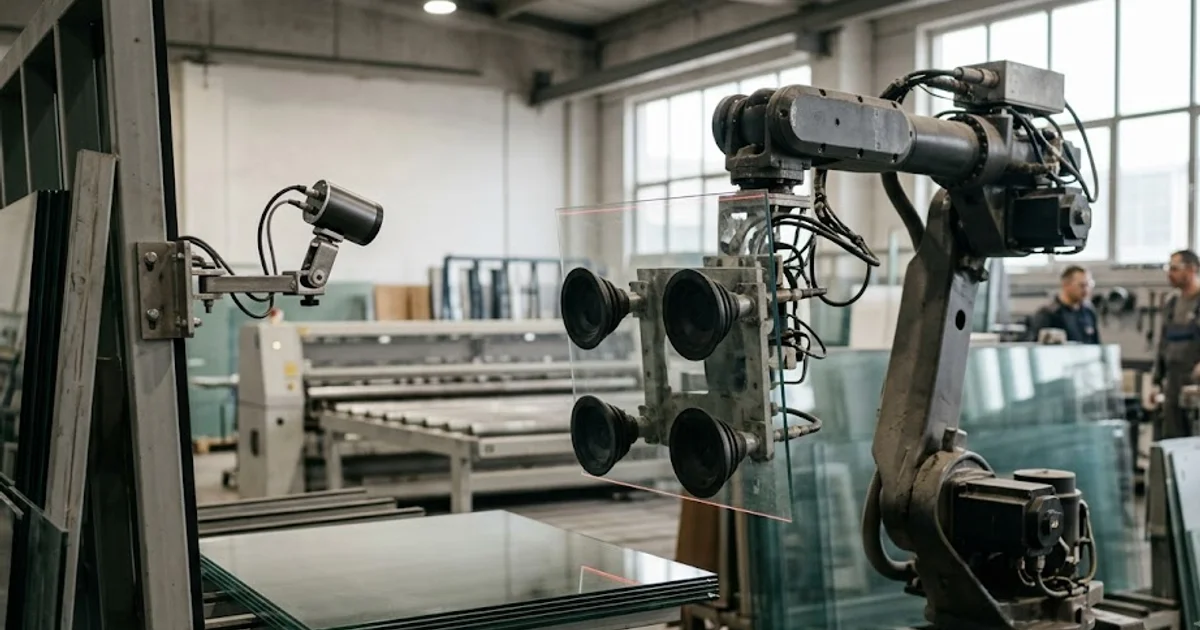
The glass-positioning work is an R&D field case, not a shipped catalog feature, and it was run at a leading glass manufacturer to solve exactly this locating problem. Two techniques did the work together. Laser-line optical detection projects a controlled line across the glass and reads where that line breaks or steps, which reveals an edge that a flat lamp cannot. Raman-shift analysis reads the coated surface by its spectral response, so a coating that hides from ordinary lighting still returns a signal the system can localise. This is the split between classical, deterministic optical methods for measurable geometry and AI for the judgement calls; for when to reach for one over the other, see rule-based vs AI machine vision.
Custom optics and lighting carried the method on a standard edge base. Adente Vision is an edge-AI visual inspection unit built by ADENTE Advanced Engineering Technologies, part of the Aden Group, sold through automation system integrators. The glass project put project-specific optics and illumination in front of the same edge compute and inspection modes the standard unit uses. Because the R&D case is still R&D, the positioning accuracy for a given glass, coating and geometry is not a published number: it needs an application-specific measurement on the real panel and handling cell before anyone commits to it.
Is this positioning or defect detection, and why does the difference matter?
Positioning answers "where is the panel," while defect detection answers "is the panel good," and a glass handling line usually needs the first before it can act. A pick-and-place robot cannot lift a sheet it cannot locate, so the edge and face coordinates come first, and only then does a surface or edge-defect check add value. The glass R&D case is a positioning case: it feeds a robot the geometry it needs, reported as feature coordinates in millimetres, the same measurement path the unit uses on other geometry-and-position work.
Keeping the two jobs separate matters for scoping a project honestly. Locating clear or coated glass is a hard optics problem answered by the laser-line and Raman-shift techniques above. Grading the glass for scratches, inclusions or coating faults is a separate defect task with its own lighting and its own reference set. A cell can need one, the other, or both, and pricing effort against the wrong one is how glass vision projects overrun.
What makes each glass surface hard, and which technique answers it?
Each glass surface fails ordinary vision for a specific reason, and the R&D case paired each challenge with a technique rather than a single fixed setup.
| Glass surface challenge | Why ordinary vision struggles | Technique in the R&D case |
|---|---|---|
| Transparent float glass | Light passes through, so contrast against the background collapses | Laser-line optical detection of the edge and face |
| Coated or low-emissivity glass | The coating changes reflection across the spectrum | Raman-shift analysis to read the coated surface |
| Specular reflection and glare | Fixed lighting washes out the feature under bright reflection | Configurable lighting angle and coaxial illumination |
| Edge and face location for a robot | Presence is not enough; the pick needs a position | Feature coordinates output in millimetres to the robot |
Can a standard edge unit carry custom optics for glass?
A glass project runs custom optics and lighting in front of a standard edge base rather than a bespoke computer. The unit uses a camera of up to 12 MP with a global shutter and C-mount, configurable colour and angle lighting (diffuse, directional or coaxial), and inference on a fanless Jetson-class board, and the glass work changed the optics and illumination while keeping that edge compute and the standard inspection modes. That separation is the point of building the camera, lighting and AI in-house: a hard surface becomes an optics-and-lighting problem to be tuned, not a reason to start the whole system from scratch.
The result still leaves the unit as a normal industrial signal. Position and pass/fail carry over PROFINET, EtherNet/IP, Modbus TCP, EtherCAT or OPC UA to the robot or PLC, with 4 inputs and 4 outputs at 24V for triggering and handshakes, and every image is processed on-device so panel imagery stays on the line.
Where does a high-temperature AV-H100 fit around glass processes?
Glass is often hot, and the high-temperature AV-H100 is the variant built for the stations around a glass process, not for the clear-glass positioning case itself. The AV-H100 carries an IP54 rating and an extended operating range of 0-65 C, against 0-45 C on the standard AV-S100, while keeping the same optics, edge compute and AI modes: only the enclosure changes. Near a tempering furnace, a lamination line or a hot forming station, where ambient heat would push a standard enclosure past its range, the AV-H100 is the unit that keeps running.
This post is a spoke of the pillar guide on AI visual inspection; to see where glass positioning sits alongside the other tasks the unit runs, browse the real applications.