6 August 2026 · 6 min read · Serkan İnkaya · Mechanical Engineer, ODTÜ
What is edge AI in visual inspection?
Edge AI in visual inspection means running the trained inference model on a compute device located at the line itself, so a part is captured, classified and decided in one place without sending the image anywhere. The word edge refers to the edge of the network, the machine or cell where the work happens, as opposed to a central server or a cloud data center reached over a network.
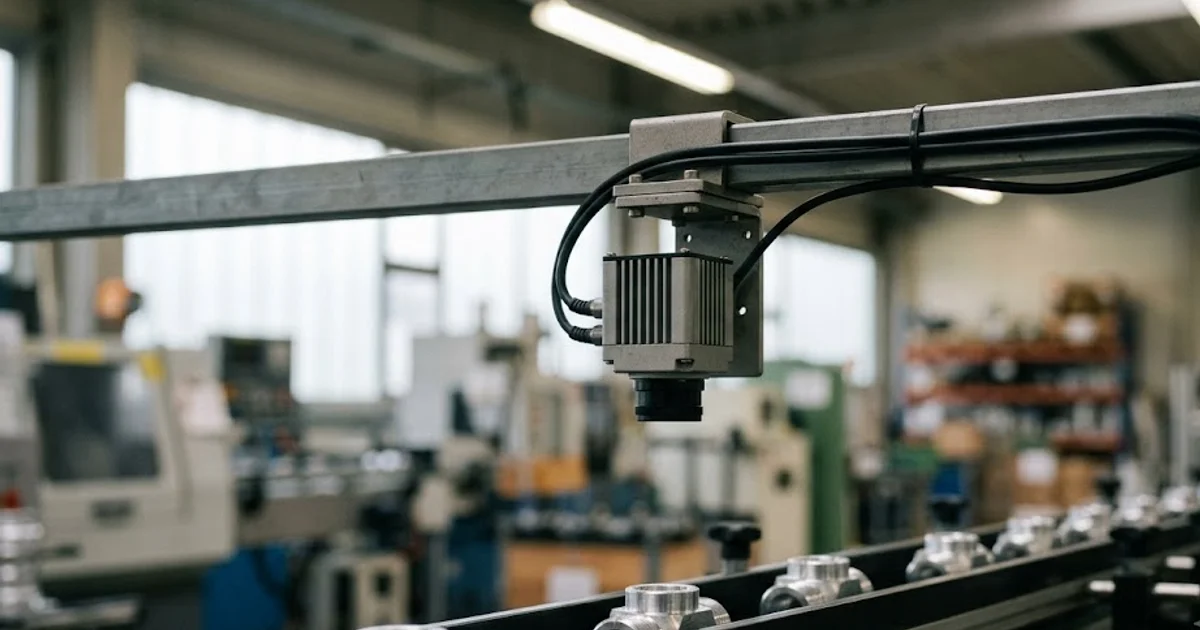
In practice the model, the compute and the camera live in or beside the same enclosure. A part triggers a capture, the on-device processor runs inference, and a pass or fail leaves as a signal the line already understands. Nothing about the decision depends on a remote service being reachable, which is the property that defines the category.
What hardware makes an inspection unit edge?
Edge inspection hardware is compute that is small, sealed and power-efficient enough to sit at the machine and still run a full inference model. In practice that means an embedded accelerator rather than a rack server. Adente Vision is an edge-AI visual inspection unit built by ADENTE Advanced Engineering Technologies, part of the Aden Group, sold through automation system integrators, and it runs inference on an NVIDIA Jetson-class board with 8-16 GB of memory, fanless, inside the enclosure, which is representative of the class of hardware the term describes.
Fanless matters more than it first appears. A fan is a moving part and an air path, so it is a maintenance item and a route for dust and coolant mist on a factory floor. Passive cooling lets the compute be sealed into an industrial enclosure and mounted at the cell without a cabinet, which is part of what makes it edge rather than data-center hardware moved closer.
Why do latency and data locality define the category?
Two properties, not a brand of chip, make inspection edge: where the decision happens in time, and where the image goes. On timing, inference on-device removes the network round-trip entirely, so the decision is bounded by the hardware rather than by traffic. On an Adente Vision installation the measured field result is about 30 milliseconds per part; the number you can commit to for a specific line depends on the parts, the optics and the lighting and needs an application-specific measurement.
Data locality is the second half. When inference runs on the unit, the part image is processed where it is captured and the decision is emitted locally, so raw imagery does not travel to a vendor server. That keeps sensitive part geometry, tooling and throughput data on the line, which is often a hard requirement for contract manufacturers and OEM-facing plants. A system that meets a tight per-part budget and keeps images on the line is edge; one that ships frames out for a decision is not, whatever hardware it uses.
How is edge AI different from a local PC?
A local PC is on-premises, but it is not automatically edge in the sense that matters here. The distinction is architectural. Edge AI folds the camera, lighting, compute and model into one sealed unit at the cell; a camera-plus-PC rig distributes them across a frame grabber, cabling, an industrial PC and often a separate GPU, each of which is a failure point, a maintenance item and a thing to secure. The table below separates the three common architectures.
| Attribute | Edge AI unit | Local PC | Cloud |
|---|---|---|---|
| Where inference runs | On the device at the line | On a separate industrial PC | In a remote data center |
| Latency per part | About 30 ms measured, deterministic | Fast, but adds cabling and OS overhead | Variable, network-bound |
| Where images go | Stay on the line | Stay in the cell, on a PC disk | Leave the plant to a server |
| Moving parts | One sealed enclosure | Camera, cabling, PC, often a GPU | Camera plus a network dependency |
| Network dependency | None for the decision | None, but a full PC to maintain | Required, a single point of failure |
Both a local PC and an edge unit keep data on-premises, so both beat the cloud on locality. The edge unit adds the reliability and integration advantages of one enclosure with no general-purpose operating system to patch and far fewer parts to fail. For the decision between edge and cloud specifically, latency, availability and data sovereignty, see the sibling post on edge vs cloud inspection.
Where does edge AI fit your line?
Edge AI fits any line where the inspection decision has to be fast, always available and kept on-premises. Because inference and the model both live on the unit, the line keeps inspecting through a network outage, and model updates arrive by USB stick for air-gapped cells, which is what makes AI quality control on an air-gapped line practical rather than theoretical. The unit combines classical computer vision with AI inference, so measurement and judgement run in the same place rather than being split between a PLC and a remote service.
For the wider method of AI visual inspection, see the pillar guide, and to match the edge hardware and enclosure to your environment, see the system page. When latency, uptime and data residency are the deciding factors, the edge-vs-cloud sibling post walks the trade-off in detail.