14 September 2026 · 7 min read · Mert Aytunur · Mechanical Engineer, University of Illinois Chicago
The expensive problem on a mixed automotive line is not a rare crack. It is the changeover: a left headlight and a right headlight look almost identical, a bumper comes in several trim variants, and if the robot runs the wrong program the part is scrapped or the cell stops. Manual sorting slows the line, and a fixed fixture cannot tell two near-identical variants apart.
This is a recognition problem before it is a defect problem, and it is exactly where an edge-AI unit that recognises the part and signals the controller earns its place. Two real deployments show how.
How does the unit tell a left headlight from a right one?
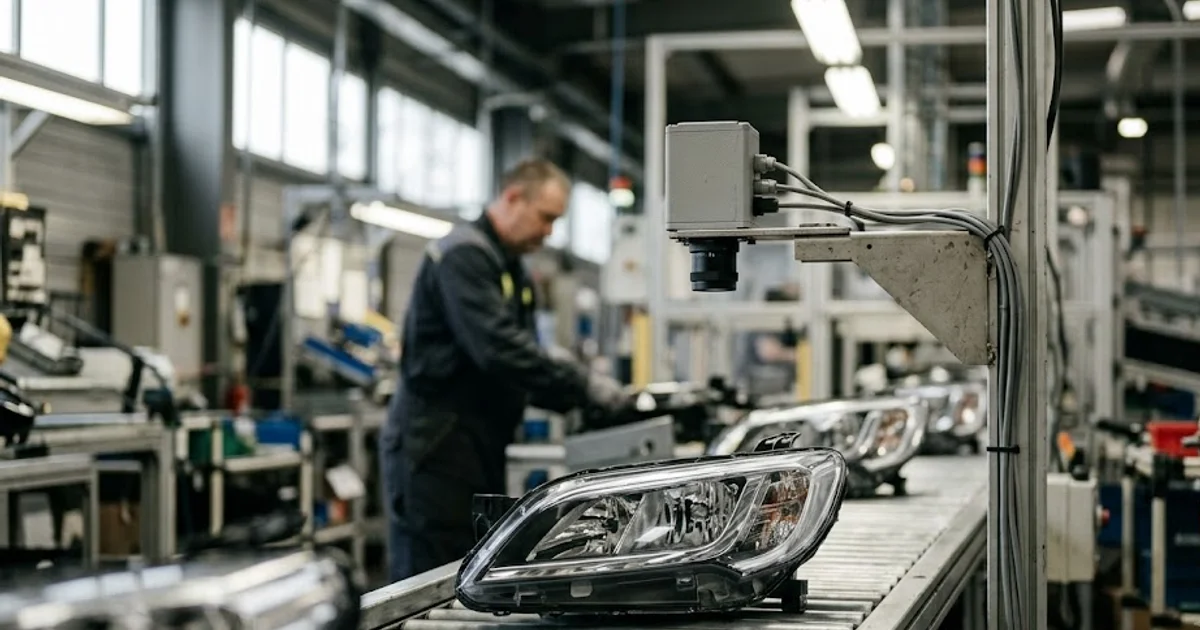
At a leading automotive OEM, an Adente Vision unit inspects headlights on a mixed line and distinguishes left from right. That recognition becomes a program-select code sent to the robot, so the robot runs the correct handling and fitting path for the part actually in front of it. No operator sorts the parts, and no mechanical fixture has to be changed between variants.
The mechanism is the hybrid approach: classical computer vision locates and measures the deterministic geometry, and the AI model makes the judgement call on which variant it is looking at. Because the decision is per-part, a run of mixed variants needs no batching. Each part is recognised as it arrives.
Can it recognise bumper variants at line speed?
On a bumper line, the same platform performs variant recognition at per-part confidence above 0.9 and carries that result to the cell controller. A confidence score is the model's certainty about the call, and a threshold turns it into a discrete signal the PLC can act on, with a safe default when the model is unsure. That keeps an ambiguous part from silently taking the wrong path.
Recognition and defect detection run on the same unit. While it identifies the variant, it can also run anomaly detection for surface and cosmetic flaws, trained on good parts only, so a scuffed or short-moulded bumper is caught in the same pass. For the wider picture of how anomaly and few-shot detection work, see the AI visual inspection guide.
Automotive tasks the unit covers on one line
| Task | How it runs | Output to the line |
|---|---|---|
| Left vs right headlight | Recognition mode, hybrid CV + AI | Program-select code to the robot over PROFINET |
| Bumper variant | Recognition at per-part confidence above 0.9 | Variant ID to the cell controller |
| Surface and cosmetic defect | Anomaly mode, trained on good parts only | Pass/fail to the PLC |
| Missing clip or fastener | Defect / assembly verification | 24V discrete reject output |
| Feature position | Measurement in millimetres | Coordinate data to the line |
The point of the table is that recognition, cosmetic defect detection, assembly verification and dimensional measurement are the same platform in different modes, not four separate systems to integrate and maintain. The measurement row gets considerably harder when the part returns almost no contrast: locating a transparent or coated panel and handing a handling robot its position in millimetres is the subject of glass inspection and positioning with AI.
How does it wire into an existing automotive cell?
The AV-S100 (IP54, 0-45 C) mounts in the cell in about 30 minutes, one person, since the unit is under 9 kg. It triggers from the line encoder or a photoelectric sensor, sends pass/fail and variant codes over PROFINET or EtherNet/IP, and drives a reject or diverter through its 24V outputs. Because inference runs on a fanless Jetson-class board inside the enclosure at about 30 ms per part, the decision keeps up with a fast index cycle and no part imagery leaves the line.
Adente Vision is an edge-AI visual inspection unit built by ADENTE Advanced Engineering Technologies, part of the Aden Group, sold through automation system integrators. For an automotive plant that means the integrator who already builds your cells can add inspection and recognition as a line item, keeping the account and the service relationship. See how the applications map to real lines, and how a hybrid of rule-based and AI vision beats a fixture-only approach for cosmetic variants.