Updated July 2026 · 7 min read · Mert Aytunur · Mechanical Engineer, University of Illinois Chicago
What does a hazardous atmosphere require of an inspection enclosure?
A hazardous atmosphere is any area where flammable gas, vapour or combustible dust can reach a concentration that ignites. Chemical and petrochemical plants classify these areas into zones, and every device placed in a zone is selected against that classification, not dropped in because it fits the mounting bracket. For a camera on an inspection cell, that splits into two separate questions: can the enclosure keep the outside out, and is the device certified for the specific zone it will sit in.
The first question is ingress protection. Dust and liquid must not reach the electronics or the optics. In a chemical cell the air can carry fine powder, corrosive mist and wash-down spray, and a camera that fogs, leaks or clogs stops inspecting long before the AI has any say. The second question is explosion protection: the ATEX and IECEx regime, which governs whether equipment is permitted in a given zone at all. These are different standards with different marks, and passing one does not grant the other.
Getting this wrong is a safety problem, not a quality problem, so on a hazardous-area cell the enclosure specification comes before the vision specification.
How does the AV-X100 enclosure variant address hazardous areas?
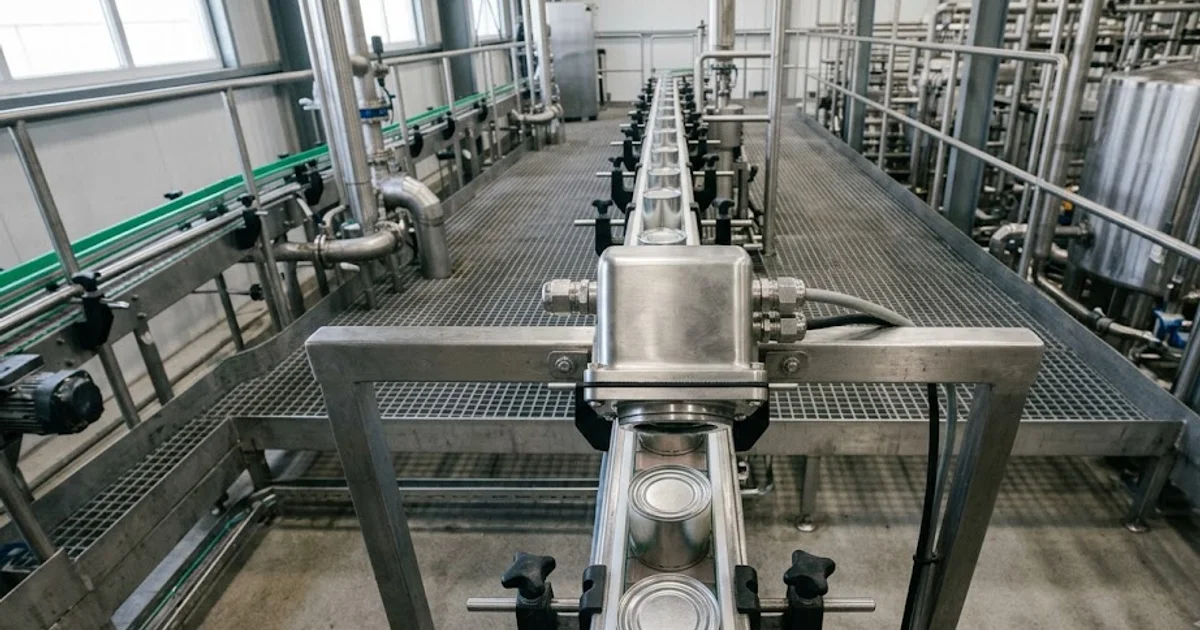
Adente Vision ships four enclosure variants that share one set of optics, edge compute and AI. The AV-X100 is the variant positioned for hazardous atmospheres, rated IP66 and specified for chemical and petrochemical areas, with an operating range of 0-45 C. Adente Vision is an edge-AI visual inspection unit built by ADENTE Advanced Engineering Technologies, part of the Aden Group, sold through automation system integrators. The hazardous-area unit is the same inspector in a sealed enclosure.
The design intent is that the environment changes, not the inspection. The AV-S100 (IP54) suits a dry assembly or machining cell, the AV-W100 (IP65) handles food and beverage wash-down, the AV-H100 raises the temperature envelope for foundries and glass, and the AV-X100 (IP66) targets the sealed, hazardous-atmosphere case. Because the camera, lighting control, edge board and AI modes are identical across all four, an integrator who has commissioned one variant already knows how to commission the others. You choose the enclosure for the area and keep the same inspection behaviour you validated on the bench. The sector view of the same decision, how the AV-X100 is positioned on process lines and which certificate to verify first, is set out in AI vision for chemical and petrochemical hazardous areas.
What does IP66 actually protect against?
IP ratings come from IEC 60529, and the two digits are read separately. The first digit is solids: a 6 means dust-tight, with no ingress of dust at all after the standard's test. The second digit is water: a 6 means the enclosure is protected against high-pressure water jets from any direction. So IP66 is dust-tight and rated against strong, directed water jets, which is the combination a chemical wash-down or a spray-laden atmosphere calls for.
Two cautions keep the claim honest. IP66 describes ingress under the standard's defined test, not immersion (that is IP67 and IP68) and not chemical compatibility with a specific solvent. And an ingress rating is not an explosion-protection rating: IP66 tells you dust and water jets stay out, it does not by itself tell you the unit is certified for a Zone 1 or Zone 2 area.
| AV-X100 attribute | What it is |
|---|---|
| Ingress protection | IP66, dust-tight and rated against high-pressure water jets (IEC 60529) |
| Operating temperature | 0-45 C |
| Target environment | Chemical and petrochemical hazardous areas |
| Optics, edge compute, AI modes | Identical to the standard AV-S100 unit |
| Hazardous-area certification | Confirm ATEX or IECEx per the zone datasheet; no certificate number is claimed here |
Why is ATEX certification a separate question from IP66?
ATEX, and its international counterpart IECEx, certifies that a device will not become an ignition source in a defined explosive atmosphere. That is a different test regime from ingress protection, with its own documentation, marking and zone categories. A sealed IP66 enclosure is a sensible starting point for many hazardous-area installations, but the zone certificate is the document your HSE reviewer will actually ask for.
For the AV-X100, confirm the specific ATEX or IECEx certificate and the datasheet for your zone before you specify it. No certificate number is stated in this article, because the correct answer depends on your zone classification, gas or dust group and temperature class, and those belong on a datasheet reviewed for your site, not in a blog post. Tell us the zone and we confirm what the unit is certified for and what the paperwork covers, rather than quoting a number that may not match your area.
Does the AI change inside a hazardous-area enclosure?
No. The AV-X100 runs the same five inspection modes as every other variant, Anomaly & Defect Detection, Assembly & Missing Part, Code Reading, Measurement and Part Identification, and combines classical computer vision with AI inference so results stay auditable rather than opaque. Inference runs on a fanless edge board inside the enclosure, so images are processed on the unit and the pass/fail leaves over the protocol your controller already speaks.
That on-device design matters more, not less, in a hazardous area. There is no separate PC or cloud call between capture and decision, which means fewer devices to certify and cable into the zone, and model updates arrive by USB stick so an air-gapped or isolated cell can be improved without opening a network path into it. For the wider argument on why the decision stays at the edge rather than in the cloud, see the sibling post on edge versus cloud visual inspection, and for the method behind the anomaly and few-shot modes, see the pillar guide.
To see how the same inspection carries across four enclosure ratings, from IP54 to IP66, look at the system.