Updated July 2026 · 6 min read · Mert Aytunur · Mechanical Engineer, University of Illinois Chicago
Why is the skills gap, not hardware cost, the real barrier?
The reason most automation integrators stay out of inspection is not the price of a camera. It is the vision engineer. Custom vision has historically needed someone who can choose an architecture, collect and label training data, tune a model and fight the lighting, and that skill set is hard to justify against irregular project flow. One inspection job a quarter does not pay a full-time specialist, so the work gets subcontracted or declined, and the account goes to someone else.
A pre-trained, productised unit changes the economics because it moves the vision expertise upstream, into the product, and out of every quote. Adente Vision is an edge-AI visual inspection unit built by ADENTE Advanced Engineering Technologies, part of the Aden Group, sold through automation system integrators, which is the point: the model, the optics and the lighting arrive configured, so what is left on your side is the automation work your team already does.
What does a pre-trained unit handle that a specialist used to?
The unit absorbs the tasks that used to require a vision engineer, and leaves you the integration. It trains on good parts only, so it learns a part from about 20 good reference images rather than a staged catalogue of every defect, and model training completes under 48 hours. Lighting is integrated with colour and angle presets, and the confidence threshold is set on-device with a live preview, so the tuning that once happened offline in a lab happens at the machine.
| Task | The old vision specialist | Now: the unit plus your team |
|---|---|---|
| Collecting training data | Staged a defect catalogue over weeks | Learns from 20 good images; trains on good parts only |
| Building the inspection logic | Coded rules per feature | Trains under 48 hours; you pick one of five modes, not code it |
| Setting up lighting | Chose and tuned lamps and angles | Lighting is integrated, with colour and angle presets |
| Tuning the decision | Hand-tuned parameters offline | Confidence threshold set on-device with live preview |
| Adding a new part | A fresh mini-project each time | Capture 20 images and retrain, no re-engineering |
The five modes, Anomaly & Defect Detection, Assembly & Missing Part, Code Reading, Measurement and Part Identification, are selected for the job rather than programmed from scratch, and the unit combines classical computer vision for measurement with AI inference for judgement, so the result stays auditable instead of a black box you cannot explain to a customer.
Which of your existing skills transfer to running the unit?
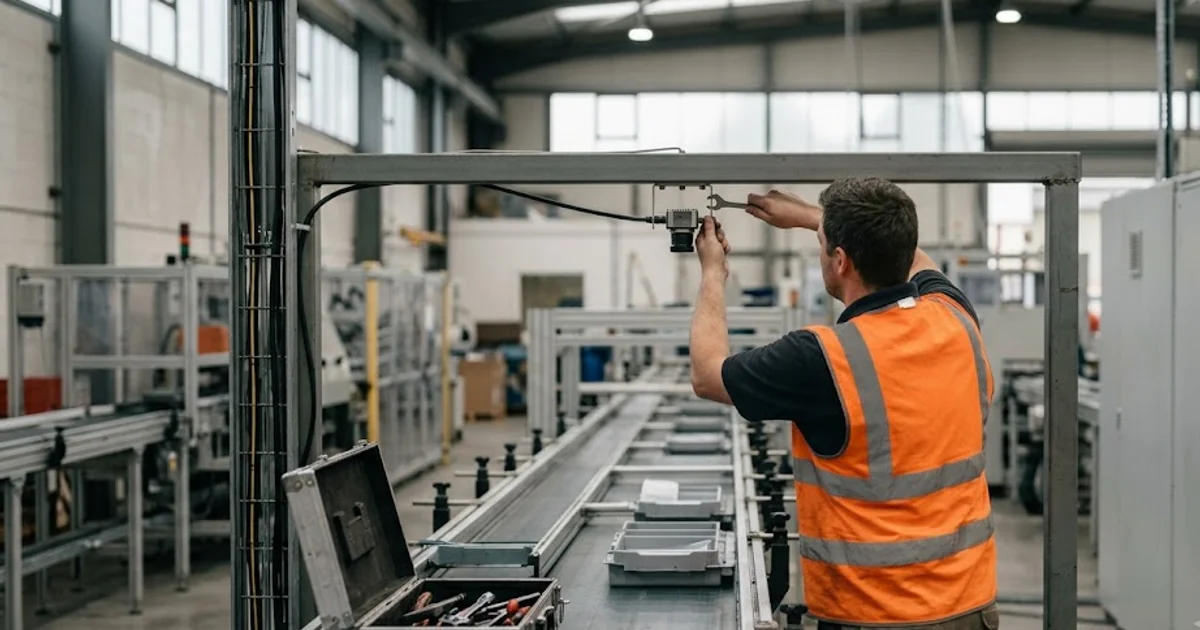
The skills that run the unit are the ones your team already has. Mounting a 9 kg enclosure, wiring four inputs and four outputs at 24V, mapping a pass or fail onto a PLC over PROFINET or EtherNet/IP, and triggering off an encoder or a photoelectric sensor are automation tasks, not computer-vision research.
What used to demand a specialist, choosing a model architecture, labelling datasets and tuning a network, now sits inside the unit. Your engineer aims the camera with the on-device preview, sets the confidence threshold against known good and bad parts, and wires the decision into the cell.Public anomaly-detection datasets show how anomaly methods learn "good" from a limited set of examples, which is the same principle the unit applies from about 20 images. On the protocol side, the same PROFINET specification your team already integrates against is the one the unit uses to hand a result to the PLC.
How long does it take your team to get certified?
Certification is short and arranged case by case. Because the unit ships pre-trained and is configured on-device, the learning curve is about the inspection workflow and the acceptance criteria, not about machine learning theory, so the ramp is far shorter than training a vision engineer.
In practice that is a matter of days rather than a course of weeks, and the exact scope is set bespoke with your team and the parts you inspect, so treat any single figure as illustrative rather than a fixed programme. The goal is narrow and reachable: your people can mount, aim, configure and wire the unit, set a defensible threshold, and hand a customer a pass or fail on their PLC without a specialist in the room.
Where does Adente engineering pair with your team?
On the first deployment, Adente engineering pairs with your team rather than handing over a box and leaving. We sell through integrators, not around them, so the aim is that your people own the second install on their own. The first job is where the certification becomes real: we work the part, the lighting and the threshold together, and you keep the customer relationship and the service revenue. What keeps that true after the first job, when retraining and a second station come up, is set out in the post on how the integrator keeps the customer.
Because inference runs on-device on a fanless Jetson-class board, there is no PC or cloud dependency to support and no data leaving the line, which keeps the ongoing burden on your side small. That is also what makes reselling and integrating the same unit viable without a vision team behind you. For whether to build a vision capability in-house or buy a productised unit, see build vs buy in machine vision; for the full inspection method, see the pillar guide on AI visual inspection.